
The quiet flight of Alain Talbot
 Alain Talbot artwork
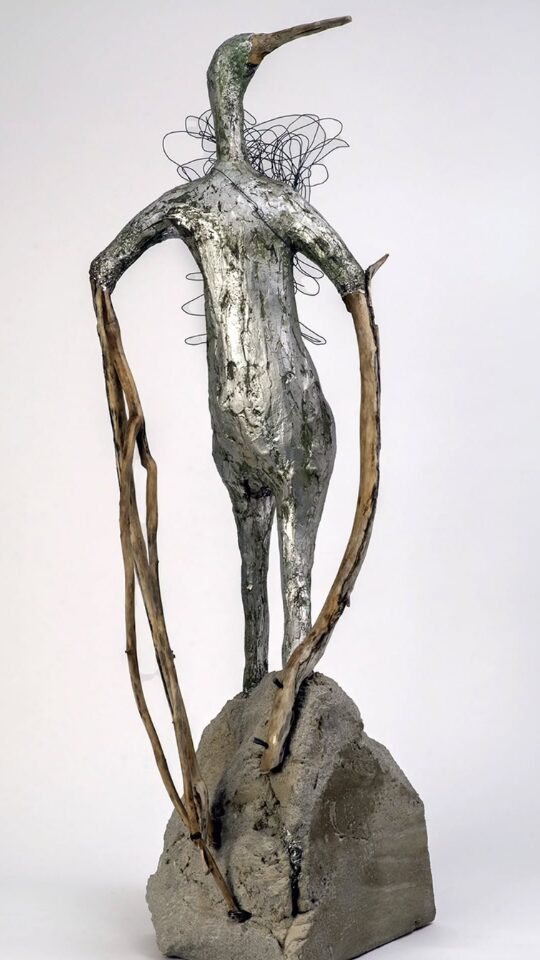
When I first encountered Alain Talbot’s work, I didn’t try to analyze it. I didn’t look for influences, techniques, or references. I let the pieces speak in their own way, even if only through photographs and the quiet impressions they leave behind. His sculptures have a strange calmness to them, a kind of inner steadiness that doesn’t ask for attention but somehow holds it. The birds he creates - those long‑necked, thin‑legged creatures with bodies shaped from wood, metal, or stone - feel less like objects and more like beings. They carry a softness that is hard to explain. You sense that they were made by someone who understands fragility, someone who knows how easily things break and how carefully they must be held.
Talbot’s life story makes this softness understandable. He moved through different crafts not because he was searching for something missing, but because each material opened a new way of thinking. Drawing, sculpting, shaping hair, carving wood, polishing stone, building artistic boxes - none of it feels random. It feels like a long conversation with matter. He never forced materials to obey him; he learned how they breathe, how they resist, how they yield. That patience shows in every piece he makes. You can see the years in the surfaces, the quiet discipline in the lines, the respect in the textures.
His paintings carry a different kind of energy. They move. They shift. They feel like weather. The colours - orange, blue, green, red - don’t fight each other. They blend the way memories blend, without clear borders. And somewhere in the middle of that movement, there is always a shape, a gesture, a white mark that feels like a voice. Talbot doesn’t paint abstractions to hide meaning; he paints them because feeling rarely has a clean outline. His canvases are not puzzles. They are atmospheres.
What I admire most is how naturally his work balances strength and tenderness. The sculptures look solid, grounded, almost ancient, yet they carry a vulnerability that makes you slow down. The paintings are full of motion, yet they never overwhelm. Talbot’s art doesn’t try to impress. It tries to be honest. And honesty, in his case, is quiet. It’s the kind of quiet that comes from someone who has spent decades working with his hands, someone who has learned that beauty is not created by force but by attention.
I’ve never seen his sculptures in person, but even through photographs and the stories of people who have, there’s a strange sense of presence in them. His birds look as if they’re aware of the space around them - aware of light, of stillness, of the quiet that gathers in a room. They carry themselves with a kind of deliberate calm, as if they’re listening to something we can’t hear. Even in images, they don’t feel like imitations of life; they feel like life held in another form, paused for a moment, waiting.
His career shows the same steadiness. He founded galleries, taught carving, trained painters, organized exhibitions. He didn’t isolate himself. He built spaces where others could grow. That generosity is part of his art. You can feel it in the way his works stand - not as monuments, but as companions. They don’t dominate the room. They share it.
Over the years, Talbot’s career has unfolded with the same quiet determination that lives in his work. He didn’t chase visibility; he built it slowly, through commitment rather than ambition. His exhibitions across Quebec - Jonquière, Berthier‑sur‑Mer, Rivière‑Éternité, Île d’Orléans - were never about spectacle. They were about presence. He showed up, year after year, offering new pieces that carried the same sincerity but deeper maturity. The symposiums he joined, the honors he received, the roles he took on as honorary president - none of it feels like a pursuit of status. It feels like recognition of a man who has given decades to his craft. And beyond the exhibitions, there is the teaching: the carving classes, the painting workshops, the guidance he offered to beginners and professionals alike. Talbot didn’t just build a career; he built a lineage. He shaped hands, minds, and practices. He created communities that continue to breathe because he once stood at their center, not as a leader, but as a craftsman willing to share what he knew.
Talbot’s vision has never felt fashionable or calculated. It feels lived. It feels earned. He doesn’t chase trends or try to fit into movements. He follows an inner rhythm, one that seems shaped by years of working with materials that demand patience. Wood, stone, metal - they don’t rush. And Talbot learned not to rush with them.
What stays with me most is the gentleness. In a world full of loud, aggressive art, his work feels like a breath taken slowly. His birds look ready to fly, but they choose to stay. His colors look ready to explode, but they choose to settle. His sculptures look heavy, but they carry lightness. Everything in his art feels like a decision made with care.
Talbot’s work doesn’t need a gallery to stay with you. Even when you encounter it only through photographs, conversations, or the quiet impressions that drift in from afar, it has a way of lingering. It settles somewhere in the back of your mind like a soft, steady melody. It reminds you that beauty doesn’t need noise or spectacle; it needs sincerity. And sincerity is exactly what he gives - through every carved line, every layered color, every fragile bird balanced on impossibly thin legs, carrying more grace than their structure should allow.
I write this not as a critic, not as a historian, but as someone who has spent time with his work from a distance - through photographs, through stories, through the quiet impressions that linger even when you haven’t seen the pieces in person. And somehow, even without standing in the same room with them, something shifts. Something softens. Something opens. There is a tenderness in his art that reaches you regardless of the medium through which you encounter it. Talbot’s work doesn’t try to change the world; it simply reminds you that the world still has room for gentleness, for balance, for that fragile kind of beauty that doesn’t raise its voice. And for me, that is more than enough.
 Alain Talbot artwork