
Walter Ciandrini: The Cartographer of Emotional Reality
 Walter Ciandrini artwork
There are artists who paint what they see, and there are artists who paint what they feel. Walter Ciandrini belongs entirely to the second kind - the rare kind - the kind who turns the human figure into a vessel of inner climate, who treats the face not as a likeness but as a landscape. Even without ever standing in front of his canvases, even without the physical weight of pigment and texture, his work reaches you. It reaches through tone, through silence, through the strange intimacy of figures that seem to exist halfway between presence and memory. His art is not about the world outside; it is about the world inside. And that world is where this essay begins.
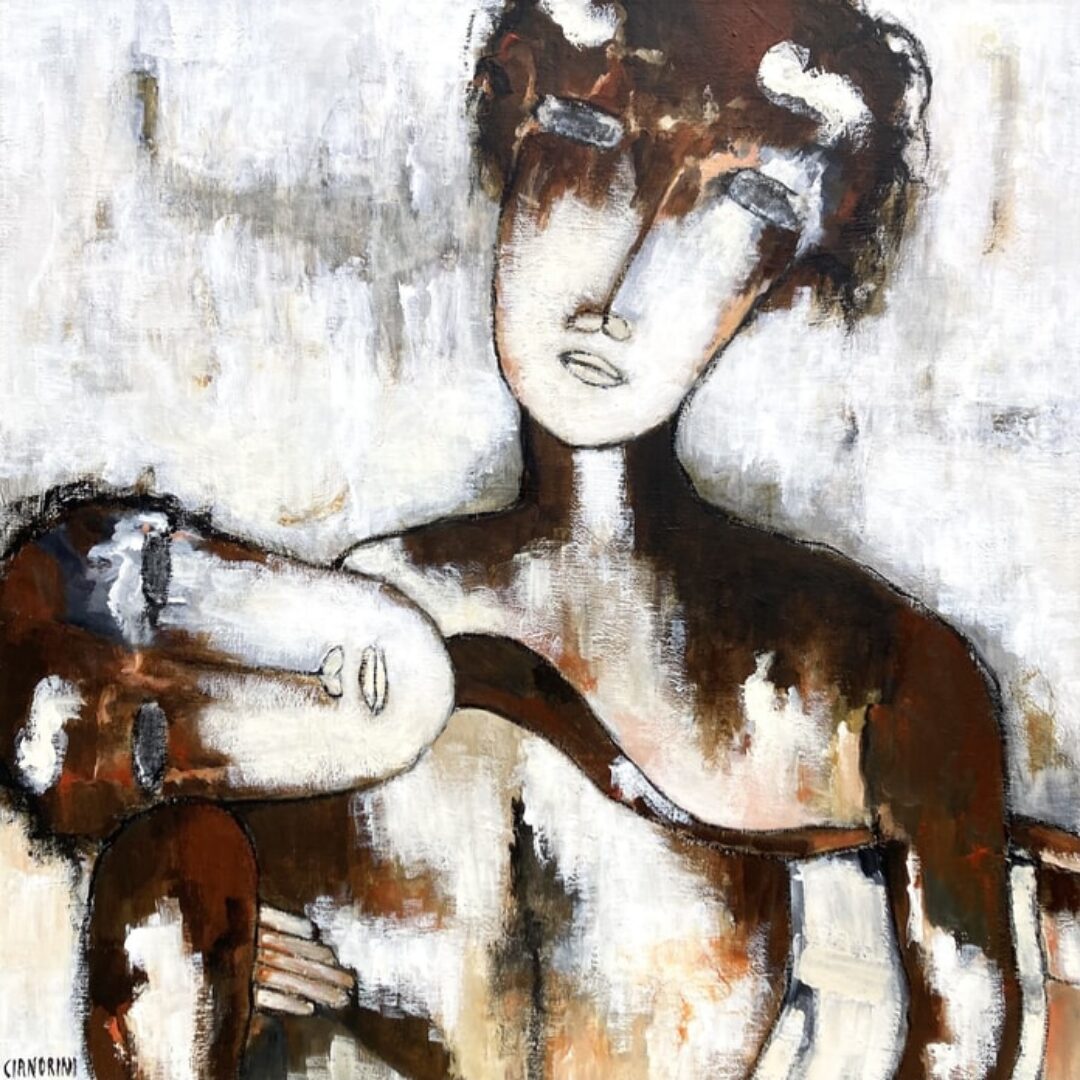
There is something unmistakable in Walter Ciandrini’s world, something that arrives quietly, without spectacle, yet settles deeply. His faces, those layered silhouettes, those figures leaning into one another, carry a kind of emotional gravity that doesn’t depend on physical proximity. Even through a photograph, even through a digital reproduction, they feel like they are breathing. His art doesn’t chase realism; it chases resonance. He once said he doesn’t paint reality but the reality of emotions, and that sentence becomes the key to everything he creates - not a slogan, but a truth lived through line and colour.
Ciandrini’s Italian origin is not just a detail; it is a foundation. Italy gave him the instinct for the human figure, the discipline of contour, the respect for the body as a vessel of meaning. But Alsace gave him the quiet. The muted mornings, the earthy palette, the soft melancholy of a region shaped by centuries of layered identities. In that environment, his coloųrs found their voice - ochres that feel like old walls, browns that feel like soil after rain, reds that glow like embers rather than flames. Even without seeing the paintings in person, you sense that his palette is not chosen; it is lived.
When you look at his work, the line arrives before the image. That sinuous, sensitive line that curves like a thought trying to find its way. It’s never rigid, never ornamental. It’s a line that knows hesitation, longing, uncertainty. A line that feels human. Sometimes it barely holds the figure together, sometimes it lets the figure dissolve into another. It reminds you that identity is not a fixed shape but a moving contour, always shifting, always searching. His line feels like handwriting - not of words, but of emotions.
The faces he paints are suspended in time, but not frozen. They are caught in that fragile moment between feeling and expression, when something is about to surface but hasn’t yet found its form. Their eyes are narrow, their mouths closed, their features elongated as if stretched by thought. They don’t speak, but they are full of speech. They don’t look at you, but they let you look into them. And even through a digital image, that quiet exchange happens - you begin to see your own emotional landscape reflected back. His figures are mirrors, but mirrors of interiority.
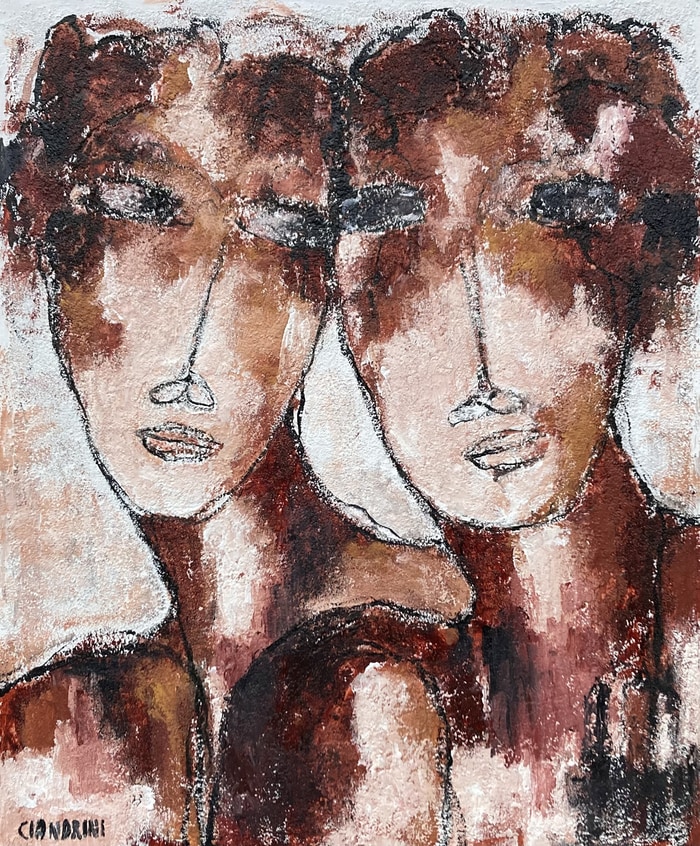
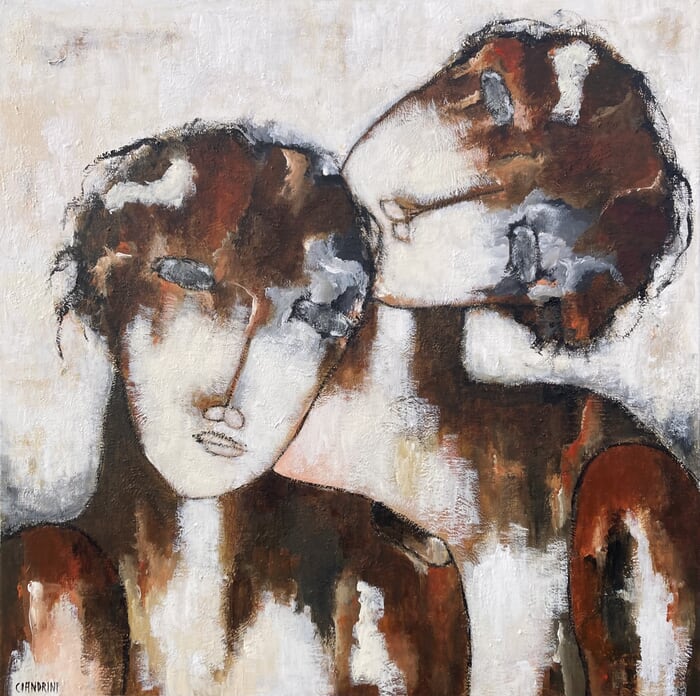
What stays with you is the way his figures multiply. One face becomes two, two become three, silhouettes overlap, merge, lean into each other. It’s not a stylistic trick. It’s a truth about being human. We are never singular. We carry our past selves, our hidden selves, our imagined selves. We carry the people we loved, the people we lost, the people we wish we could be. Ciandrini paints this multiplicity without explanation, without theory. He simply lets the figures coexist, as they do inside us. Even when seen from afar, this layering feels like memory.
 Walter Ciandrini artwork
His colours are warm but never sentimental. They feel lived-in, like the tones of skin, clay, dust, old paper. They create an intimacy that is not soft but deep. When he uses white, it’s never pure; it’s the white of breath, of fog, of worn fabric. When he uses black, it’s never harsh; it’s the black of shadow, of quiet corners, of night that protects rather than threatens. His palette feels like a human temperature — warm enough to comfort, muted enough to respect the fragility of emotion.
Ciandrini’s world is not the world of external reality. It is the world behind the ribs, behind the eyes, behind the gestures. He paints the moment when a person withdraws into themselves, when they listen to their own inner weather. His figures are not performing; they are being. And that being is tender, vulnerable, unguarded. He doesn’t chase likeness; he chases truth. And truth, in his art, is always emotional. It’s the truth of solitude, of longing, of connection, of the quiet ache of being human.
His journey from Italy to Alsace is not just geographical; it is psychological. Italy taught him how to draw the body. Alsace taught him how to listen to it. In Italy, he learned structure. In Alsace, he learned silence. And in that silence, he discovered the emotional resonance that now defines his work. His evolution is not a break from tradition but a deepening of it - a movement from the visible to the invisible, from the outer contour to the inner vibration.
There is a dialogue in his paintings, but it’s not between the figures. It’s between the viewer and themselves. His art doesn’t tell stories; it awakens them. It doesn’t explain emotions; it invites them. Even when you’ve never stood in front of the canvas, the invitation is there. You don’t interpret - you feel. You feel the weight of your own solitude, the softness of your own longing, the quiet presence of your own memories. His paintings are not windows; they are thresholds.
The solitude in his figures is not cold. It’s the solitude of someone who knows themselves. The solitude of someone who has made peace with their inner world. His characters are alone, but not lonely. They are self-contained, introspective, dignified. They carry their stories without needing to reveal them. And in that restraint, there is immense beauty. Ciandrini understands that the most profound emotions are the ones that remain unspoken.
Every figure he paints feels like it carries a secret. Not a dramatic secret, but a human one - a memory, a regret, a hope, a fear. He doesn’t expose these secrets; he protects them. His art respects the privacy of the soul. It acknowledges that every person is a universe, and that universe cannot be fully mapped. His paintings are acts of empathy, not intrusion.
Even through photographs or digital reproductions, his works retain their intimacy. They feel like they are speaking to one person at a time. They create a small pocket of quiet in the middle of whatever space you’re in. A place where you can breathe differently. A place where you can listen to yourself. His art doesn’t demand attention; it offers refuge.
Sometimes his figures feel like shadows, sometimes like memories, sometimes like dreams. But they always feel human. They always feel close. They always feel true. Ciandrini paints the human condition without drama, without spectacle, without ornament. He paints it with honesty, with tenderness, with a deep understanding of how fragile and beautiful it is to exist.
And perhaps that is why his work reaches you even from a distance - because it doesn’t rely on the physical presence of the canvas. It relies on the emotional presence of the viewer. Walter Ciandrini paints inner worlds, and inner worlds don’t need proximity; they need openness. His art enters quietly, stays gently, and leaves something behind - not an impression, but a resonance, a small shift in how you understand the human face, and maybe even your own.
 Walter Ciandrini artwork