
The face after the face
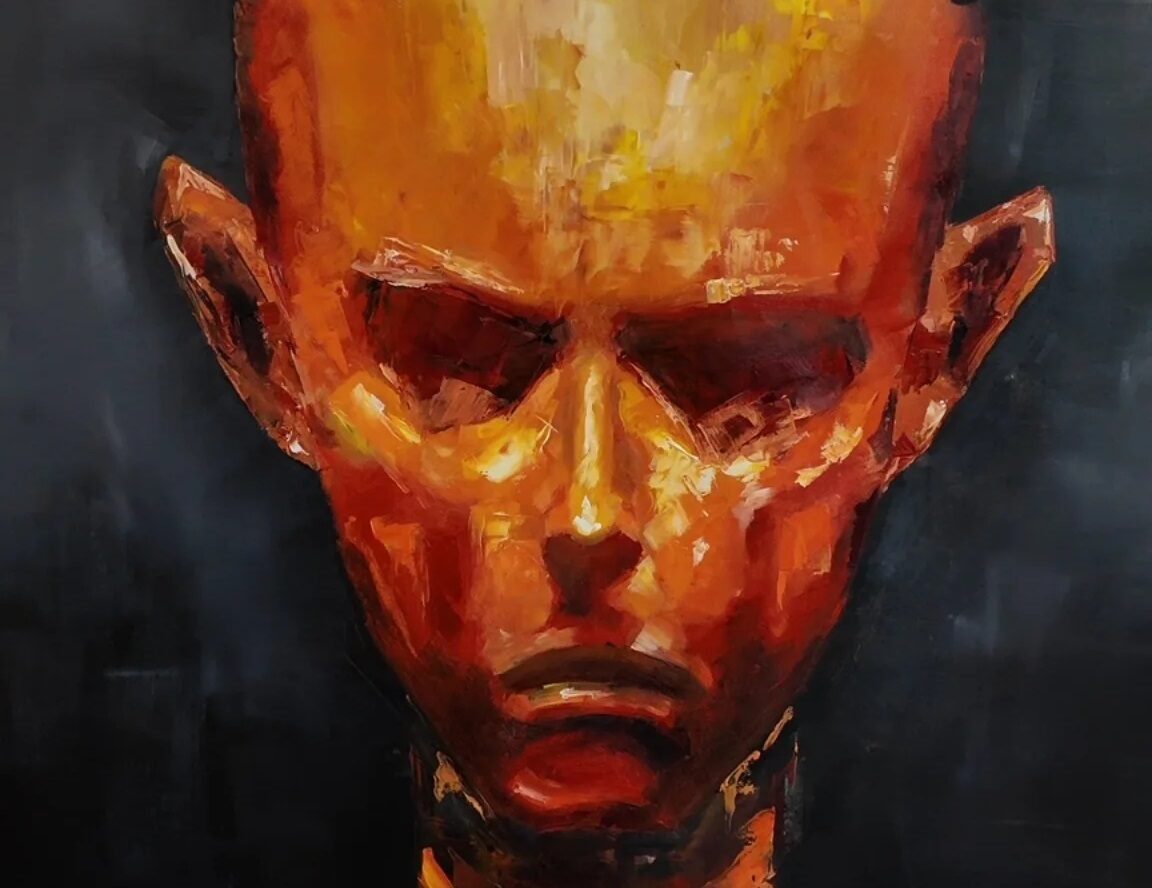
Paul Schaefer’s paintings can be approached first as portraits, but to remain at the level of portraiture would be to overlook what makes them psychologically and culturally compelling. His figures inhabit an unstable territory between recognition and disappearance, beauty and injury, tradition and contemporary anxiety.
At first glance, one encounters the familiar authority of oil painting: the human face, the body, the material density of flesh, the accumulated history of European portraiture. Yet Schaefer repeatedly interrupts the promise that a portrait traditionally makes. A portrait normally tells us that a person can be encountered through their visible appearance; it offers the face as a passage toward identity. Schaefer’s faces, however, often seem to close that passage. The eyes may be obscured, removed, distorted, or rendered psychologically inaccessible; the figure remains present while the possibility of fully knowing the figure becomes uncertain. This creates an unusual tension. His paintings are beautiful enough to invite contemplation, but disturbing enough to make contemplation unstable. They seem to ask not simply who a person is, but whether a human being can ever be adequately represented by the image of a body. In this sense, Schaefer’s work belongs to a long European history of representing the human figure while simultaneously questioning what lies behind appearance. The paintings carry echoes of religious art, Old Master portraiture, Expressionism and contemporary figurative painting, yet they do not simply reproduce any of these traditions. They use their visual authority against themselves. The recognizable face becomes a site of uncertainty; the carefully painted body becomes evidence of vulnerability; the traditional beauty of oil painting becomes the surface beneath which something darker and less easily articulated is taking place.
This makes Schaefer particularly interesting within the cultural atmosphere of the present. Contemporary Western life is increasingly organized around images of the face. We photograph ourselves, construct identities through profiles, display ourselves on social media, encounter strangers through screens, and participate in a culture in which visibility has become almost synonymous with existence. The face is no longer merely a physical feature; it has become a social instrument, a digital identity, a public performance. Against this background, Schaefer’s damaged or inaccessible faces acquire a significance that extends beyond formal experimentation. His paintings seem to resist the contemporary demand that a person should be immediately legible, attractive, recognizable and available to the gaze of others. The figures do not simply present themselves. They withhold themselves. This withholding is crucial. It introduces mystery into an age of excessive visibility. The paintings therefore occupy a strange position between the ancient and the contemporary: their material language belongs to the long history of European painting, while their psychological problem belongs very much to the present. They ask what happens to identity when appearance becomes unreliable, what happens to the self when the face no longer guarantees recognition, and what remains of human presence when the image through which we ordinarily encounter another person becomes damaged. Schaefer’s work can consequently be read as an exploration of the fragile border between the visible person and the invisible interior life. His paintings are not simply about faces. They are about the impossibility of completely seeing another human being.
THE FACE AS A THRESHOLD BETWEEN OUTER AND INNER LIFE
The most fundamental element in Schaefer’s artistic world is the face. Throughout Western art, the face has been treated as one of the primary locations of identity. A face tells us that an individual is present; it distinguishes one person from another; it communicates emotion; and, in many philosophical and religious traditions, it functions as a symbolic meeting point between the material and spiritual dimensions of existence. We instinctively search another person’s eyes when we want to understand them. We look for recognition, fear, sadness, desire, intelligence and trust. The eyes appear to provide access to something hidden inside the body. Schaefer’s treatment of the face interferes with precisely this expectation. When the eyes disappear or become damaged, the viewer loses the most immediate route toward psychological identification. The figure remains physically present, but the supposed doorway into consciousness is closed. This is what makes the paintings more profound than simple images of mutilation or darkness. The absence is not only physical. It is epistemological: it concerns the limits of what one person can know about another. We can see the skin, the posture, the contours of the skull, the clothing and the marks of the painter’s hand, but we cannot be certain that we have reached the person behind these surfaces. The face therefore becomes a threshold rather than a conclusion. Schaefer seems interested in the moment when representation reaches its limit and the visible human being becomes once again mysterious.
This mystery has an important relationship to portraiture itself. Traditional portrait painting often contains an implicit promise: that the sitter possesses a coherent identity which can be captured through careful observation. The painter studies the face and reconstructs it on canvas; the viewer subsequently encounters that face and believes that the individual has, in some sense, survived through the image. Schaefer complicates this entire process. His figures look as though they have survived representation but not entirely escaped it. The painting does not simply preserve identity; it demonstrates its instability. The face can be beautifully rendered and simultaneously made strange. This contradiction creates a psychological tension that runs through his work. We recognize the human form immediately, yet the person remains inaccessible. We therefore become conscious of our own desire to complete the image. The viewer begins to imagine the missing eyes, the hidden expression, the unseen emotional state. In this sense, the paintings become participatory. The artist does not give us the entire psychological reality of the subject; instead, he forces us to confront the gap between what is visible and what we want to know. The missing element becomes psychologically larger than the visible one. Absence becomes a form of presence.

BETWEEN THE OLD MASTER AND THE WOUNDED MODERN WORLD
Schaefer’s relationship with the history of European painting is essential to understanding the atmosphere of his work. His use of oil, his attention to flesh and his concentration on the human figure place him within a tradition extending through Renaissance, Baroque and nineteenth-century painting. Yet he does not appear interested in reconstructing the confidence of those traditions. Instead, he takes their visual vocabulary and introduces a modern psychological disturbance into it. This produces a particularly compelling temporal ambiguity. His paintings can look old because of their materiality, their attention to the body and their seriousness toward portraiture, but they do not feel psychologically old. The figures belong to a world in which certainty has already been damaged. This is where the comparison with German and Central European Expressionism becomes useful. Expressionism historically rejected the idea that art should simply reproduce external reality. The distorted figure could communicate an inner reality more honestly than an accurate likeness. Anxiety, alienation, violence and spiritual uncertainty could be expressed through changes in form, colour and proportion. Schaefer’s work can be understood within this broader principle: distortion is not necessarily a failure of representation; it may be the most truthful way to represent an experience that ordinary realism cannot contain.
There is also something distinctly European in the way his paintings allow beauty and suffering to coexist. European art has repeatedly returned to the human body as a place where transcendence and mortality meet. Christian painting, in particular, developed an extraordinary visual language around wounds, sacrifice, suffering, death and resurrection. The damaged body was not necessarily meaningless; physical suffering could become the surface through which spiritual questions were made visible. Schaefer’s work should not automatically be described as religious, but the historical memory of this visual culture remains relevant. His figures possess an almost sacramental seriousness: the body is not merely decorative, and injury is not simply sensational. Flesh becomes a philosophical material. The viewer is made to contemplate the fact that the body is simultaneously the vessel of identity and the thing that eventually decays. This gives his work a quiet relationship with mortality. The face is beautiful because it is alive, but it is also disturbing because its beauty cannot be separated from vulnerability. The painting consequently exists somewhere between reverence and unease. It treats the human figure as something worth looking at while simultaneously reminding us that the figure cannot remain intact forever.
THE PSYCHOLOGY OF THE HIDDEN EYE
The recurring problem of the eye allows Schaefer’s work to enter the territory of psychology. The eye is both an organ of vision and one of the most powerful symbols of consciousness. We see with the eyes, but we also use them to imagine that another person sees, feels and thinks. When a painting removes or obscures the eyes, it therefore attacks the symbolic centre of interpersonal recognition. The effect can be uncanny. The viewer looks at a human face and expects reciprocity: the figure should, in some imaginary sense, look back. But the damaged or absent eye prevents that exchange. The painting becomes one-directional. We can look at the subject, but the subject cannot completely return our gaze. This changes the psychological relationship between viewer and figure. Instead of meeting another consciousness, we encounter an object that appears to contain an inaccessible consciousness. The result is not simply horror. It can also produce empathy, loneliness and even tenderness. We become aware of how much human communication normally depends on tiny movements of the eyes, and therefore how profoundly exposed a person becomes when that form of communication is removed.
From a Jungian perspective, one could interpret these figures as images of the shadow: aspects of the human psyche that ordinary social identity suppresses or conceals. The polished public face is never the whole person. Beneath it are fear, aggression, shame, desire, vulnerability, mortality and unconscious impulses. Schaefer’s disruption of the face can therefore be understood metaphorically as a disruption of the socially acceptable persona. The viewer encounters a person after the protective mask has been damaged. This is why the paintings can feel intimate even when the depicted figures are not personally known to us. Their anonymity gives them a universal quality. They are not simply particular people; they become psychological types. The wounded face can represent the wounded self, the hidden self, the self that exists beneath social presentation. The paintings seem to suggest that identity is not a stable object but a fragile construction. We construct ourselves through faces, names, expressions, clothing and social roles, yet beneath those structures lies something less controllable. Schaefer’s figures appear to stand at precisely this boundary between the person we present and the person we cannot completely understand.
 Artwork by Paul Schaefer
SOCIAL MEDIA, VISIBILITY AND THE CRISIS OF BEING SEEN
The cultural significance of Schaefer’s work becomes even stronger when considered against contemporary digital culture. We live in a civilization that has made visibility almost compulsory. Social media encourages people to maintain a continuous visual representation of themselves. The face appears everywhere: profile pictures, selfies, videos, advertisements, dating applications, professional platforms and algorithmically distributed images. We are constantly invited to make ourselves visible and interpretable. The contemporary individual is increasingly expected to communicate identity through images. One might therefore say that modern culture has turned the face into a kind of currency. To be visible is to participate; to be aesthetically appealing is to gain attention; to have a recognizable image is to possess a public identity. Schaefer’s paintings can be interpreted as a quiet resistance to this system because his figures repeatedly refuse complete visibility. Their faces do not provide immediate access. Their identities are fractured, concealed or psychologically unavailable. They interrupt the smooth relationship between seeing and knowing that digital culture encourages.
This becomes especially intriguing because Schaefer himself exists within contemporary image culture. His painting process can circulate through digital platforms, and audiences encounter his art through photographs and videos before encountering the physical paintings themselves. There is therefore a productive contradiction at the centre of his practice. The artist participates in a culture of extreme visibility while producing images that question visibility. The more images surround us, the more difficult it may become to experience genuine intimacy. We can see thousands of faces every day without actually knowing any of the people behind them. Schaefer’s damaged faces can consequently be understood as images of this paradox: we have never had more access to faces, yet we may have become less certain about what a face tells us about a person. The painting slows this process down. Unlike the rapid movement of digital images, an oil painting requires sustained attention. Its material surface resists instant consumption. The viewer must remain with the image and tolerate not understanding it immediately. In this way, the paintings can function almost as an antidote to digital speed. They return the face to mystery.
MASCULINITY, VULNERABILITY AND THE UNHEROIC BODY
Another important dimension of Schaefer’s work is its treatment of the human body in relation to masculinity. European art has a long history of representing the male body as strong, rational, heroic and autonomous. Male figures have traditionally been associated with physical power, military achievement, intellectual authority and social status. Even portraiture often presented men as individuals who possessed the world rather than as individuals exposed to its violence. Contemporary culture, however, has increasingly questioned this model of masculinity. The idea that a man should be emotionally invulnerable, physically dominant and psychologically self-contained has become increasingly difficult to sustain. Schaefer’s figures can be read within this broader transformation. His bodies are not primarily heroic bodies. They are vulnerable bodies. Their faces can appear damaged, anonymous, exposed or psychologically uncertain. They do not proclaim mastery. They ask to be looked at as human beings.
This is particularly important because vulnerability is not presented as weakness alone. In Schaefer’s paintings, vulnerability becomes a form of dignity. The wounded figure remains worthy of attention. The damaged face remains beautiful. This refuses the cultural logic according to which only perfection deserves admiration. There is something deeply humanistic in that refusal. A person does not become less human because their identity is fractured, their body is vulnerable or their inner life cannot be clearly communicated. Indeed, the inability to completely understand another person may be precisely what demands respect. The painting therefore moves away from domination and toward contemplation. Instead of telling the viewer what the subject means, it allows the subject to remain partly unknowable. This can be read as an alternative form of masculinity: not the man who controls the gaze, but the person who exists within the gaze and remains vulnerable to it.
DEATH, MELANCHOLY AND THE POSSIBILITY OF THE SOUL
Underlying all of these themes is the question of mortality. Schaefer’s paintings are haunted by the knowledge that the body is temporary. The face is the centre of identity, yet the face changes, ages and eventually disappears. Oil painting itself has a strange relationship with this fact. To paint a person is to preserve an image of something that cannot remain physically present forever. Portraiture is therefore always connected to death, even when it depicts the living. The painted face becomes a substitute for a person who is absent. Schaefer intensifies this old problem by damaging the face within the painting itself. Instead of pretending that representation can defeat mortality, he exposes its failure. The image survives, but the identity remains uncertain. The painting preserves the body while simultaneously reminding us that preservation is incomplete.
This is where the distinction between nihilism and melancholy becomes important. Schaefer’s darkness does not necessarily suggest that nothing matters. On the contrary, the darkness may exist because something matters profoundly. Melancholy emerges when beauty is recognized as temporary, when intimacy is understood to be incomplete, when another person remains fundamentally unreachable. The paintings seem to inhabit this emotional territory. They do not necessarily deny meaning; they make meaning difficult to possess. This opens a possible spiritual dimension. Whether or not Schaefer consciously thinks of his work in religious terms, his paintings repeatedly return to a question that has preoccupied European culture for centuries: what is a human being beyond the visible body? If the eyes disappear, if the face becomes damaged, if the exterior image fails, does the person disappear with it—or does something remain? The painting cannot answer this question, and perhaps its strength lies precisely there. It creates a space in which the viewer feels the absence of an answer. The soul, if one chooses to use that word, becomes not something represented but something sensed through what cannot be represented.
 Artwork by Paul Schaefer
BEYOND THE VISIBLE: THE PLACE OF SCHAEFER’S ART
Paul Schaefer’s work becomes most compelling when it is understood not as a collection of dark portraits but as an investigation into the instability of human presence. His figures exist at the intersection of several historical and contemporary conditions: the European tradition of portraiture, the psychological violence of Expressionism, the spiritual seriousness of religious imagery, the contemporary culture of digital visibility, the crisis of identity and changing ideas of masculinity. None of these elements alone explains the paintings. Their meaning emerges from their collision. The old language of oil painting encounters a generation that has grown up surrounded by screens. Traditional beauty encounters contemporary anxiety. The human face, historically treated as a site of identity, becomes a site of uncertainty. The result is a body of work that can be understood as an attempt to recover mystery in a culture increasingly committed to making everything visible, identifiable and consumable.
Perhaps the most important thing about Schaefer’s paintings is therefore their refusal to finish the person. They do not give us a complete psychological explanation. They do not tell us who the figure is or what exactly happened to them. Instead, they create an absence that the viewer has to inhabit. This makes the paintings less like statements and more like questions. What does it mean to see another person? Can we ever truly know another consciousness? How much of identity exists in the face, and how much exists somewhere beyond it? Why are we disturbed when a familiar human image becomes incomplete? Why do we continue to search for the eyes even when they have been taken away? These questions move the paintings beyond aesthetic effect and into philosophy. Their darkness becomes a means of thinking.
AFTER THE FACE: WHAT REMAINS OF A HUMAN BEING?
The deepest power of Paul Schaefer’s work may lie in the fact that it does not offer an easy answer to the problem it creates. The damaged face remains a face. The human figure remains human even when its most recognizable characteristics are obscured. This suggests that identity may be deeper than appearance, while simultaneously admitting that appearance is one of the primary ways through which human beings encounter one another. We need faces in order to recognize people, but we also know that a face never gives us complete access to another person. Schaefer transforms this contradiction into painting. His figures stand between presence and absence, between being seen and remaining hidden. Their eyes are gone, but their humanity remains. Their faces are wounded, but their dignity does not disappear. Their identity becomes less certain, but their emotional power increases. The paintings therefore do not merely destroy the portrait; they reveal how fragile the portrait has always been. Every portrait is an attempt to hold a person inside an image, and every image ultimately fails to contain the complexity of the person it represents.
Seen in this light, Schaefer's relationship with European artistic tradition becomes more than a matter of style. He inherits a civilization that has spent centuries attempting to understand the human being through the body: through religious icons, saints, kings, lovers, martyrs, soldiers, philosophers and anonymous faces. Yet the contemporary world has introduced a new problem. We now live among more human images than any previous generation, but images have not necessarily brought us closer to other human beings. They may even have intensified our distance. The face has become ubiquitous, while genuine interiority remains inaccessible. Schaefer's paintings respond to this contradiction by taking the face away from easy consumption. They make the viewer work. They slow recognition down. They make us experience the discomfort of not knowing. In doing so, they restore something that contemporary visual culture often removes: the right of another person to remain mysterious. This mystery is not emptiness. It is a form of dignity. To say that another person cannot be completely understood is also to say that another person is more than an image.
Ultimately, Schaefer's art can be understood as a meditation on the fragile boundary between appearance and being. His figures remind us that the human body is both extraordinarily visible and profoundly unknowable. We carry our identities on the surface of our faces, yet the deepest parts of consciousness remain hidden even from those who love us. We construct public selves, digital selves, social selves and private selves, but none of these completely exhausts what it means to be a person. Schaefer's paintings occupy the space left between these versions of the self. Their darkness is not simply an aesthetic of despair; it is a way of approaching the places where language and representation stop working. The missing eye becomes the missing answer. The damaged face becomes the damaged certainty that we can ever fully know ourselves or anyone else. And yet the painting remains beautiful. That beauty is crucial, because it suggests that mystery does not have to be solved in order to have value. Perhaps this is where Schaefer's work ultimately reaches beyond portraiture: it does not ask us merely to look at another person. It asks us to confront the strange fact that every human being we encounter contains an interior world that we can approach, imagine, love, fear and interpret, but never completely enter. The face remains before us, the soul remains beyond it, and the painting exists precisely in the distance between the two.
 Artwork by Paul Schaefer