Shifting body of myth: material, memory and transformation in the work of Aimilios Metaxas
2026 m. spal. 16 d. 13:16,
Komentarų nėra
Thresholds of Living History
In the world Aimilios Metaxas shapes, painting becomes a threshold where inherited memory thickens into matter, where mythology ceases to be a distant archive and instead rises as a living current guiding the movement of pigment across the surface. His biography, rooted in Athens yet stretched between London and Shanghai, reveals an artist who inhabits cities not as coordinates but as cultural climates that imprint themselves on his sensibility: the Mediterranean’s mythic luminosity, London’s intellectual rigor, Shanghai’s velocity and density. What emerges from this triangulation is not a nostalgic return to spiritual iconography or craftsmanship, but a reanimation of them — a way of letting archetypal narratives breathe inside contemporary painterly language. His artist statement deepens this understanding, showing how intuition, emotional undercurrents, and material responsiveness guide his hand, turning identity into a fluid negotiation between personal experience, collective memory, and mythic frameworks. Silk, with its translucency and unruly softness, becomes central to this negotiation: a material that resists control, that forces the painter into dialogue rather than domination, that carries the shimmer of Byzantine heritage while demanding a contemporary responsiveness. Through these gestures, Metaxas creates a painterly world where history is not preserved as distant memory but experienced as a living force, continually reshaped through material, gesture, and imagination.
Myth as a Breathing Structure
Within the evolving practice of Aimilios Metaxas, mythology is not treated as a symbolic vocabulary borrowed from antiquity but as a breathing structure that continues to shape contemporary identity. His Athens‑born sensibility carries the weight of archetypal narratives, yet he refuses to let them calcify into decorative motifs; instead, he reinterprets them through a painterly language that is unmistakably of the present. Figures in his work emerge, dissolve, and intertwine, occupying spaces where human, animal, and spiritual forms coexist in states of perpetual transformation. This fluidity mirrors the way myth operates in cultural consciousness — not as fixed stories but as shifting frameworks through which societies understand vulnerability, belonging, and renewal. Metaxas’s movement between London, Athens, and Shanghai intensifies this dynamic, exposing him to environments where mythic thinking intersects with global modernity. The result is a body of work that treats myth not as a relic but as a living organism, one that continues to mutate, adapt, and breathe through the materiality of paint.
Material as a Living Continuum
The material choices in Metaxas’s practice reveal how deeply he understands painting as a living continuum of inherited memory. Silk, central to his process, is not merely a surface but a historical thread connecting him to his Byzantine heritage and his family’s lineage of silk merchants. Its softness, translucency, and unpredictable bleeding force him into a state of responsiveness, where control must be relinquished and intuition must guide the gesture. This dialogue between painter and material becomes a metaphor for the way cultural history behaves: porous, unstable, shaped by forces larger than the individual. The paint’s movement across silk — shifting, bleeding, resisting containment — echoes the movement of memory itself, which refuses to remain fixed and instead continually reshapes identity. Through this material intimacy, Metaxas transforms painting into a site where personal history and collective memory intertwine, where the surface becomes a living archive that records not only pigment but the emotional and cultural forces that drive its motion.
Rhythms of Transformation
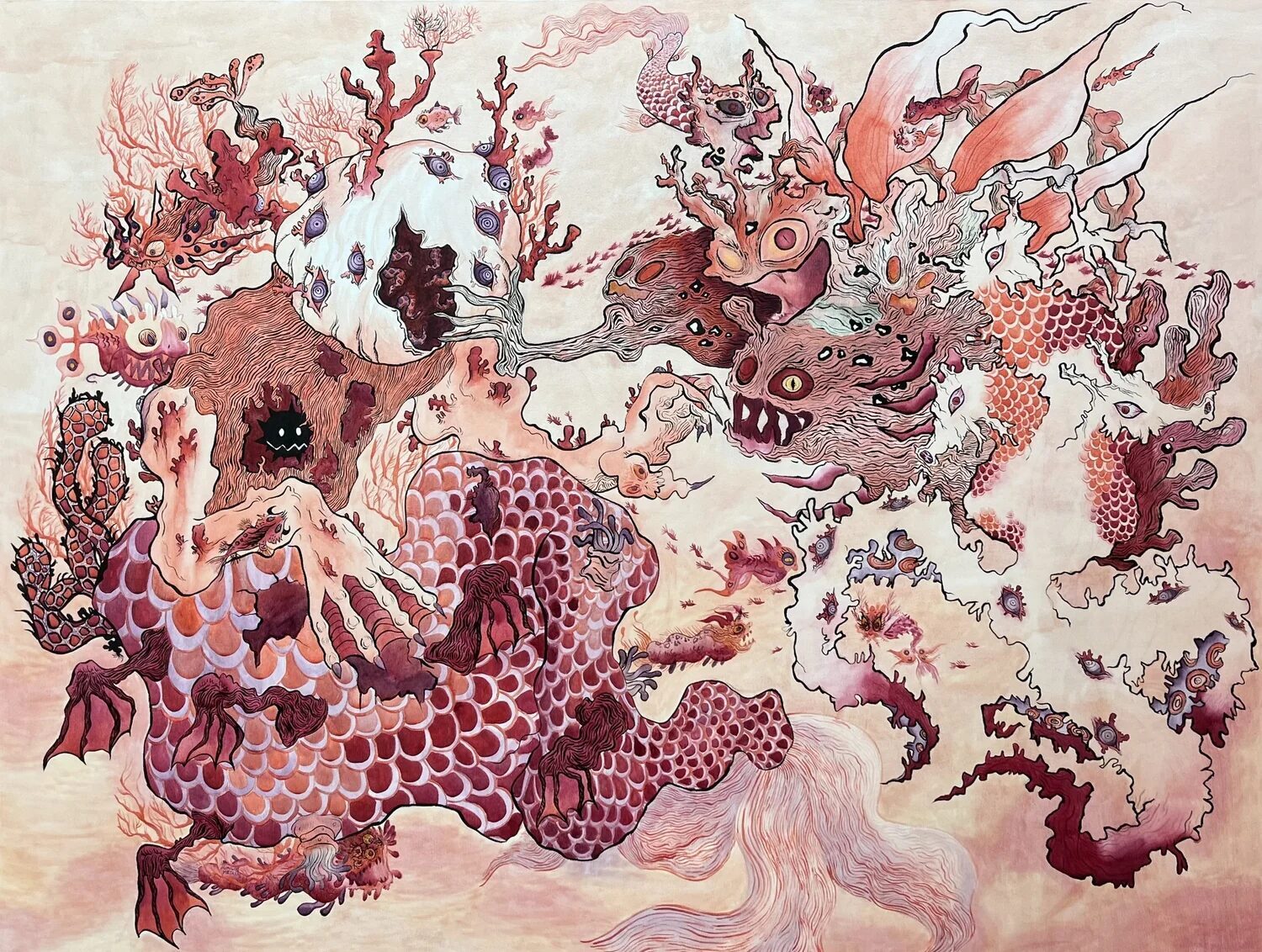
Movement is the central pulse of Metaxas’s painterly world, a rhythm that rejects fixed compositions and instead creates surfaces that unfold gradually, demanding slow looking and sustained contemplation. His brushstrokes layer themselves into rhythmic fields, where forms are never fully stable and where identity appears as something ongoing rather than complete. The red, fevered works visible in his public presence suggest a diagrammatic intensity, as if emotional states were being mapped through saturated chromatic fields; the cooler blue compositions, by contrast, feel architectural, meditative, shaped by the quiet tension between surface and depth. Across these registers, the painter’s commitment to transformation remains constant: figures dissolve into atmosphere, narratives fragment into gesture, mythic echoes merge with contemporary sensibility. In this continual unfolding, Metaxas constructs a visual language where identity is not declared but discovered, not fixed but in motion, shaped by the interplay of memory, material, and mythic imagination.
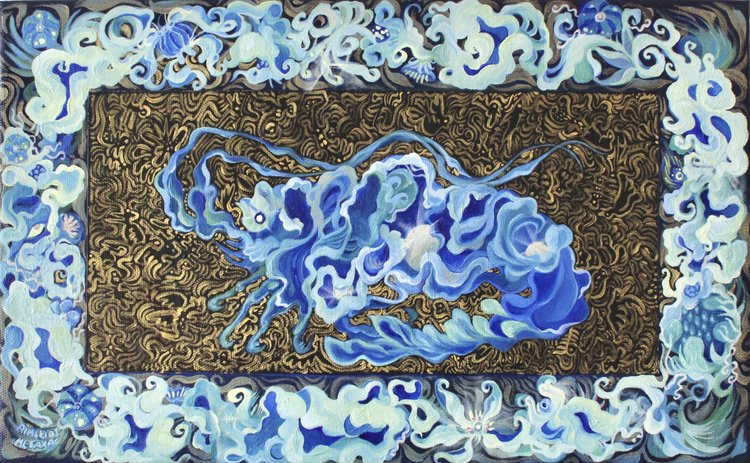 Artwork by Aimilios Metaxas
Cultural Atmospheres and the Cities That Shape Him
The cultural geography surrounding Aimilios Metaxas forms an invisible architecture beneath his work, shaping the emotional climate in which each painting emerges. Athens gives him mythic inheritance and the weight of ancestral narratives; London offers critical discourse, institutional rigor, and the intellectual friction of the RCA environment; Shanghai provides velocity, density, and the electric hum of global modernity. These cities do not simply host him — they imprint themselves on his palette, his gestures, his sense of rhythm. The Mediterranean’s brightness becomes a kind of internal illumination; London’s gray atmospheres sharpen his structural thinking; Shanghai’s neon‑charged nights introduce a sense of restless movement. His residency at the Swatch Art Peace Hotel intensifies this cultural layering, placing him in a space where artists from around the world collide, exchange, and reshape each other’s sensibilities. In this triangulated existence, Metaxas becomes a painter of cultural atmospheres, someone who translates the emotional weather of cities into surfaces where myth, memory, and contemporary life converge.
Artistic Dialogue Across Worlds
Metaxas’s presence within the broader world of art reveals a practice that thrives on dialogue — between traditions, between materials, between communities of artists who challenge and expand his vision. His Instagram grid, far from being a mere portfolio, becomes a public stage where the evolution of his work unfolds: fevered reds, architectural blues, dissolving figures, studio moments, residencies, exhibitions. Each post becomes a fragment of an ongoing conversation with viewers, institutions, and fellow artists. His connection to the RCA painting cohort situates him within a lineage of painters who push the boundaries of material experimentation and conceptual depth. Meanwhile, his engagement with myth and cultural memory places him in dialogue with contemporary artists who seek to reanimate historical narratives rather than preserve them. Through these interactions, Metaxas positions himself not as an isolated creator but as a participant in a living, global conversation about identity, transformation, and the future of painterly language.
Spaces Where History Breathes
Ultimately, the world of Aimilios Metaxas is one where history breathes — not as a distant echo but as a living force that shapes the present. His paintings create spaces where mythic frameworks merge with contemporary sensibility, where inherited memory becomes a material presence, where figures shift between states of being. The unpredictability of silk, the fluidity of pigment, the rhythmic layering of brushstrokes all contribute to a visual language that resists closure, inviting viewers into a slow, contemplative encounter. In these spaces, identity is not a fixed construct but a continual unfolding, shaped by cultural atmospheres, emotional undercurrents, and the restless movement of history itself. Through this practice, Metaxas offers a vision of art that is not merely representational but transformative — a world where material, memory, and myth converge to create surfaces that feel alive, porous, and perpetually in motion.
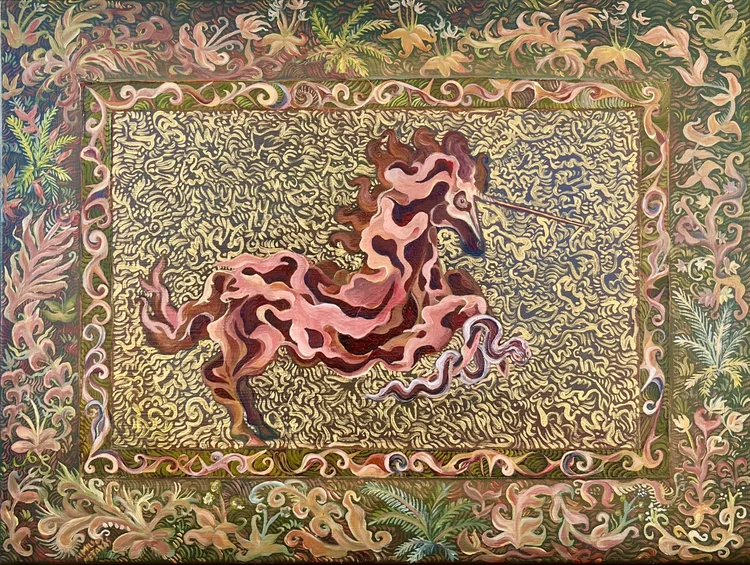 Artwork by Aimilios Metaxas
Mythic Bodies in Contemporary Space
Aimilios Metaxas constructs mythic bodies that inhabit contemporary space without losing their ancestral resonance. His figures — human, animal, spiritual — do not appear as illustrations of old stories but as emergent presences shaped by the emotional climate of the present. They twist, dissolve, and reform within chromatic atmospheres that feel both ancient and immediate, as if myth were unfolding in real time rather than being recalled from distant memory. This approach allows him to treat mythology as a living architecture of identity, one that adapts to shifting cultural conditions and personal experiences. In his paintings, mythic bodies become carriers of vulnerability, renewal, and transformation, occupying spaces where the boundaries between past and present blur. Through this interplay, Metaxas creates a visual language that situates myth not behind us but around us, shaping the emotional and psychological landscapes of contemporary life.Chromatic Worlds and Emotional Architecture
In the chromatic worlds shaped by Aimilios Metaxas, color becomes an emotional architecture that organizes the viewer’s experience long before any figure or narrative emerges. His saturated reds pulse with a kind of internal heat, suggesting states of urgency, conflict, or metamorphosis, while his expansive blues open into meditative zones where thought slows and perception deepens. These chromatic environments are not decorative choices but psychological climates, each one calibrated to evoke a specific mode of attention. Within them, forms appear as if summoned by the atmosphere itself — bodies rising from color, dissolving back into it, shaped by gradients rather than outlines. This approach allows Metaxas to construct paintings where emotion is spatial, where color behaves like terrain, where the viewer enters a world defined by temperature, rhythm, and intensity. Through these chromatic architectures, he creates environments that feel both intimate and vast, inviting viewers to inhabit emotional states that unfold gradually, like weather systems moving across the surface of the mind.Art as a Landscape of Cultural Memory
Metaxas’s work unfolds as a landscape of cultural memory, a terrain where inherited narratives, personal experiences, and collective histories intersect. His paintings do not depict landscapes in the traditional sense, yet they create environments shaped by the emotional and cultural forces that define his world. Athens contributes mythic luminosity; London introduces structural rigor; Shanghai adds velocity and density. These atmospheres merge into chromatic fields where memory behaves like terrain — shifting, eroding, accumulating, revealing new layers over time. In this landscape, figures appear as travelers moving through zones of transformation, shaped by the cultural currents that surround them. Metaxas’s ability to translate these atmospheres into painterly form allows him to construct spaces where viewers can encounter memory not as a static archive but as a living environment. Through this approach, his art becomes a landscape where cultural history breathes, moves, and reshapes itself in response to the present. Artwork by Aimilios Metaxas
Continuum of Living Myth
In the unfolding world shaped by Aimilios Metaxas, painting becomes a continuum where myth, memory, and material co‑inhabit a single breathing field. His practice reveals how inherited narratives can be reanimated through contemporary gesture, how silk can become a site of emotional negotiation, how cities imprint themselves on the rhythm of pigment. Across his surfaces, identity appears not as a fixed declaration but as a slow emergence, shaped by cultural atmospheres, intuitive movement, and the unpredictable dialogue between painter and material. What Metaxas ultimately offers is a vision of art as a living organism — one that absorbs history, transforms it, and releases it again in forms that feel porous, luminous, and perpetually in motion. In this continuum, painting becomes a space where myth is not remembered but lived, where memory is not preserved but reshaped, where the present breathes with the quiet pulse of ancestral echoes.7 Aimilios Metaxas from personal archive