
George Fotiadis: Between Witness and Vision
The Photograph Before the Photograph
Photography is often described as the art of capturing a moment, but such a definition is too simple to explain what happens in the strongest photographic images. A camera can capture thousands of moments in a single day, yet only a small number of those moments become photographs in the deeper artistic sense. The difference lies not necessarily in the equipment, the technical quality of the image, or even in the importance of the subject. It lies in the photographer's capacity to recognize something within reality before reality disappears. The photograph, therefore, begins before the shutter is pressed. It begins with attention, with expectation, with the ability to notice relationships between bodies, gestures, light, space, colour and silence.
George Fotiadis's photographic career can be understood precisely through this movement from recording to seeing. A professional photojournalist since 1993, Fotiadis has worked with photographic press agencies, newspapers and magazines, covering political, social and sporting events, while also developing a practice that extends into wedding photography, fashion, architecture, aerial photography and personal photographic projects. His professional history is important because it places him inside one of photography's most demanding environments: the world of events, where reality does not wait for the photographer and where the image must often be discovered rather than constructed. Yet the development of his work suggests that journalism was not simply a profession for Fotiadis; it became an education in observation. The discipline of photographing events taught him that reality is continuously changing, that gestures last only fractions of a second, that human relationships appear and disappear almost immediately, and that the photographer must remain alert to the unexpected. From this foundation emerges a more artistic understanding of photography, one in which the camera is not merely a machine for preserving evidence but an instrument for discovering visual relationships that might otherwise remain invisible. Fotiadis's photography becomes especially interesting when considered through this tension between witness and vision: between the obligation to remain faithful to what is happening and the artistic desire to recognize within what is happening a deeper visual order.
 Image courtesy of George Fotiadis
The Education of the Unseen
The most revealing aspect of Fotiadis's development may be the importance he gives to learning how to see one's own weaknesses. Photography is frequently taught through technique: aperture, shutter speed, exposure, lenses, focus, composition and post‑production. These are necessary elements, but they do not explain why one photograph remains in the mind while another disappears immediately. The more difficult education is perceptual. It involves learning to understand why an image works, why another fails, why a seemingly insignificant gesture can become powerful, or why a technically perfect photograph can remain emotionally empty. Fotiadis's own educational philosophy reflects this understanding. His photography seminar describes the difficulty photographers face in discovering a personal style and, importantly, in recognizing the strengths and weaknesses within their own photographs. His stated purpose is not simply to improve technical ability but to develop technical and creative perception and to help photographers discover photographs that other people simply do not see. This idea is fundamental to understanding his own practice. The photographer is not merely someone who possesses a camera; the photographer is someone who develops a particular relationship with visibility. There are things everyone sees, things only the photographer notices, and finally things that become visible only after the photographer has learned how to look differently. Fotiadis's work is situated in this third territory. His photography suggests that seeing is not a passive act. It is a form of knowledge.
This idea becomes even more significant when considering the relationship between technical competence and artistic maturity. A photographer may know exactly how to expose an image and still not know where to point the camera. Another may understand composition but remain trapped inside a predictable visual vocabulary. The challenge is therefore not simply to control the camera but to develop a sensitivity to situations. This sensitivity cannot be reduced to rules. It is closer to intuition, although intuition itself is usually the product of years of experience. The experienced photographer begins to anticipate visual relationships before they fully form. He notices the person who is about to turn, the shadow that is about to cross a face, the moment when two figures briefly create a geometric relationship, or the instant when the background suddenly changes the meaning of the foreground. This is why photojournalism can become an extraordinary artistic education. The photographer is forced to respond to reality rather than manufacture it. He must learn to trust observation. He must understand that the image is not always waiting in an obvious place. Sometimes it is at the edge of the event, in the space between the principal subjects, in the background, in an accidental reflection or in the silence that follows a dramatic moment. Fotiadis's development can therefore be understood as an education in peripheral vision: learning to see not only what the event declares itself to be, but what quietly happens around it.
 Image courtesy of George Fotiadis
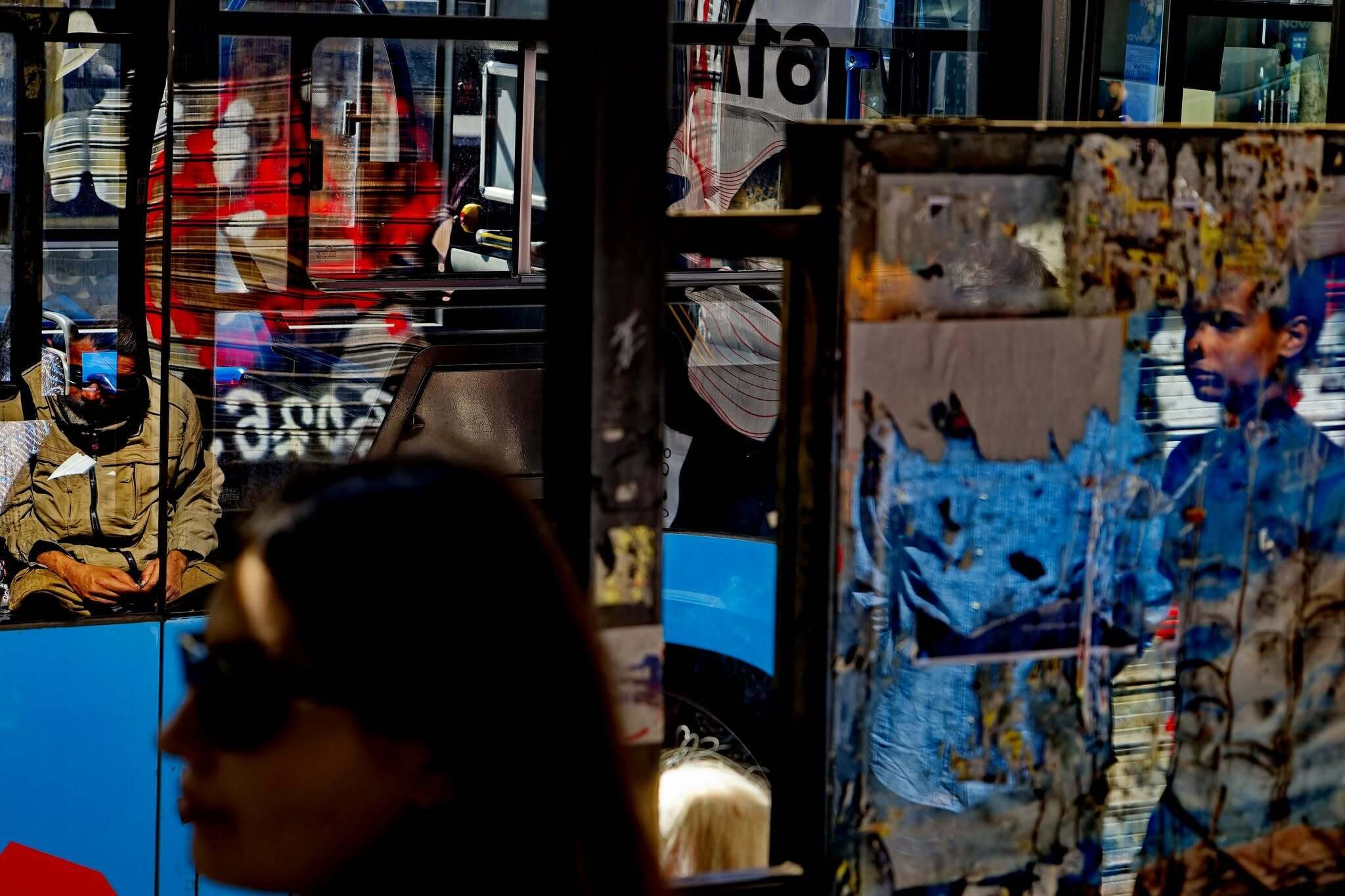
The Mature Vision: The City as a Layered Surface
This mature vision represents a shift from documenting events to interpreting reality. It is no longer about what happened but about what can be seen when reality reorganizes itself into visual meaning. It is a form of photography that requires patience, alertness, sensitivity to peripheral detail, and an ability to recognize relationships that exist only for a fraction of a second. It is the culmination of decades spent observing the world with disciplined attention. It is the point where witness becomes vision.
 Image courtesy of George Fotiadis
From Recording Reality to Interpreting It
The distinction between recording and interpreting is central to Fotiadis's photography. Photojournalism requires fidelity to events, but fidelity does not mean neutrality. Every photograph is already an interpretation because the photographer chooses where to stand, what to include, what to exclude, when to press the shutter and which moment to preserve. The camera does not remove the photographer's subjectivity; it makes that subjectivity visible through framing. Fotiadis's work demonstrates this especially clearly because his photographic practice extends from public events to deeply personal and commercial environments. In each context the question changes slightly, but the underlying problem remains the same: how can the photographer remain faithful to reality while finding an image that possesses its own visual identity? His answer appears to involve restraint. Instead of imposing an image upon reality, he often allows reality to generate the image. This principle is particularly evident in his approach to wedding photojournalism. His official descriptions emphasize a discreet and unseen style in which he avoids constantly interrupting or posing the couple and instead allows the ceremony to unfold without interference. Such an approach might initially appear simply practical, but artistically it is much more significant. It changes the relationship between photographer and subject. The photographer is physically present but attempts to become visually invisible. He watches rather than directs. He waits rather than commands.
This disappearance of the photographer creates a paradox. The more invisible the photographer becomes within the event, the more visible his artistic intelligence can become within the resulting photograph. A staged image tells us that someone arranged what we see. A discreet photograph creates the impression that the image existed independently and that the photographer merely discovered it. Of course, this is never entirely true. The photographer still chose the position, the focal length, the timing and the frame. But the image gains a particular authenticity because its emotional content does not appear to have been forced. The gesture belongs to the people rather than to the photographer. The emotion emerges from the event rather than from instruction. This is where Fotiadis's photojournalistic background becomes essential to understanding his wedding photography. Instead of treating the wedding as a sequence of predetermined poses, he can treat it as a social event filled with unpredictable interactions. The bride and groom are not simply models; they are people experiencing something. Their families are not merely decorative background figures; they create an emotional landscape around the central couple. The ceremony itself becomes a theatre of gestures, glances, distance and anticipation. The photographer's task is to recognize these moments without interrupting them. In that sense, the wedding photograph becomes a form of documentary practice disguised as celebration.

Image courtesy of George Fotiadis
The Human Event
The human figure in Fotiadis's photography should therefore not be understood simply as a subject placed in front of the camera. The human figure is part of a network of relationships. A person may be important because of the expression on a face, but equally because of the distance between that person and another figure, because of the direction of a gaze, because of a shadow crossing the body, or because the surrounding architecture creates a visual tension. This is where composition becomes inseparable from observation. The photographer does not merely ask, "Who is this person?" He also asks, "What is happening between this person and the space around them?" Such questions move the photograph beyond portraiture and toward visual anthropology. Human beings reveal themselves not only through faces but through posture, distance, movement and relation. A wedding, a political event or a public gathering can therefore become a complex choreography of bodies. The photographer's eye searches for moments when this choreography becomes temporarily legible.
This approach also explains why the background is so important in strong documentary photography. An inexperienced photographer often concentrates exclusively on the main subject and treats everything else as irrelevant. A more mature photographer understands that the background can alter the entire meaning of the image. A line emerging behind a head, a second figure appearing at the edge of the frame, a patch of light on a wall or an architectural structure can transform an otherwise ordinary moment. Fotiadis's development toward stronger composition can be understood as a growing awareness of these relationships. The photograph is not simply the central object. It is the entire field. What happens at the margins can be as important as what happens in the centre. This is one of the lessons that separates visual maturity from technical competence. Technical photography often asks whether the subject is sharp and correctly exposed. Artistic photography asks whether every element within the frame contributes to the image's meaning.

Image courtesy of George Fotiadis
The World as Composition
This sensitivity becomes particularly apparent when Fotiadis turns away from human events and toward architecture and aerial photography. From above, the world changes its visual language. Streets become lines, buildings become geometric blocks, people become points, vehicles become marks, and landscapes become fields of colour and texture. The aerial viewpoint removes much of the narrative information that normally defines a place and replaces it with relationships of shape, scale, repetition and rhythm. A beach can stop being a beach and become an abstract composition of bodies, umbrellas, shadows and water. A road can become a line crossing an enormous field. A city can become a grid. This transformation is important because it demonstrates that photography does not need an extraordinary subject to create an extraordinary image. Sometimes all that is required is a different position from which to see the ordinary.
The aerial image therefore represents a kind of philosophical distance. When we photograph a landscape from the ground, we understand it through human scale. When we photograph it from above, we temporarily escape that scale. We no longer inhabit the world in the same way; we observe it as structure. This can produce an almost painterly effect. The photograph becomes less concerned with identifying the place and more concerned with relationships of form. Fotiadis's interest in architecture similarly reveals a fascination with space as an active visual element. Buildings are not simply photographed as objects. Their surfaces, angles, windows, shadows and empty spaces become compositional components. Architecture gives photography something close to a pre‑existing geometry, but the photographer still has to discover the precise viewpoint from which that geometry becomes meaningful. The building already exists; the photograph creates the relationship between the building and the viewer.
This is one of the most important distinctions between documentation and visual interpretation. A purely descriptive architectural photograph tells us what a building looks like. An artistic architectural photograph tells us how space feels when transformed into an image. It may emphasize emptiness, repetition, symmetry, scale or contrast. It may make a familiar building appear strange. It may reduce an entire structure to a fragment. In this sense, Fotiadis's architectural and aerial interests extend the same perceptual education that began in photojournalism. In both cases, the challenge is to find the image inside reality rather than manufacture reality for the image.
 Image courtesy of George Fotiadis
Light, Colour and the Poetics of the Ordinary
The movement from journalism toward personal photographic work becomes particularly revealing in Fotiadis's projects such as Waves, Cloud, Landscape January 2021 and Bottle Tree. These projects suggest a photographer increasingly interested in the visual possibilities of ordinary phenomena. The subjects themselves are not necessarily dramatic. A wave, a cloud, a winter landscape or an isolated object does not carry the immediate narrative force of a political event or social gathering. Yet this absence of narrative creates another possibility: the possibility of pure looking. When the subject does not demand an explanation, the viewer becomes more attentive to form, light, colour, texture and atmosphere. The photograph becomes less about "what happened" and more about "what was seen." Fotiadis's Cloud, for example, is explicitly presented on his site as a personal work, while his recent projects show a continuing movement toward landscape and visual experimentation. This development is significant because it suggests that the photographer's documentary eye has not disappeared; it has been transferred to another scale.The wave is a particularly revealing subject because it contains movement that can never be repeated exactly. A wave is simultaneously form and disappearance. It exists for a moment and then becomes something else. To photograph it is therefore to freeze something whose natural condition is instability. This gives the image a conceptual dimension: photography attempts to preserve what reality continually destroys. The same principle applies to clouds. A cloud is almost pure transformation. It has no permanent form, yet the photograph gives it one. In this sense, the camera does not merely record the cloud; it temporarily fixes a state of being that would otherwise vanish. The photograph becomes an act of resistance against disappearance. Fotiadis's interest in such subjects can therefore be read as a movement toward a more contemplative photography, one in which time itself becomes visible.
Colour plays a similarly important role in this movement. Colour is not simply decorative. It changes the psychological temperature of an image. A cold winter landscape can create a feeling of stillness; a bright urban colour block can create tension or vibrancy. In his mature work, colour becomes a structural element — not decoration, but meaning.