
The symphony without sound
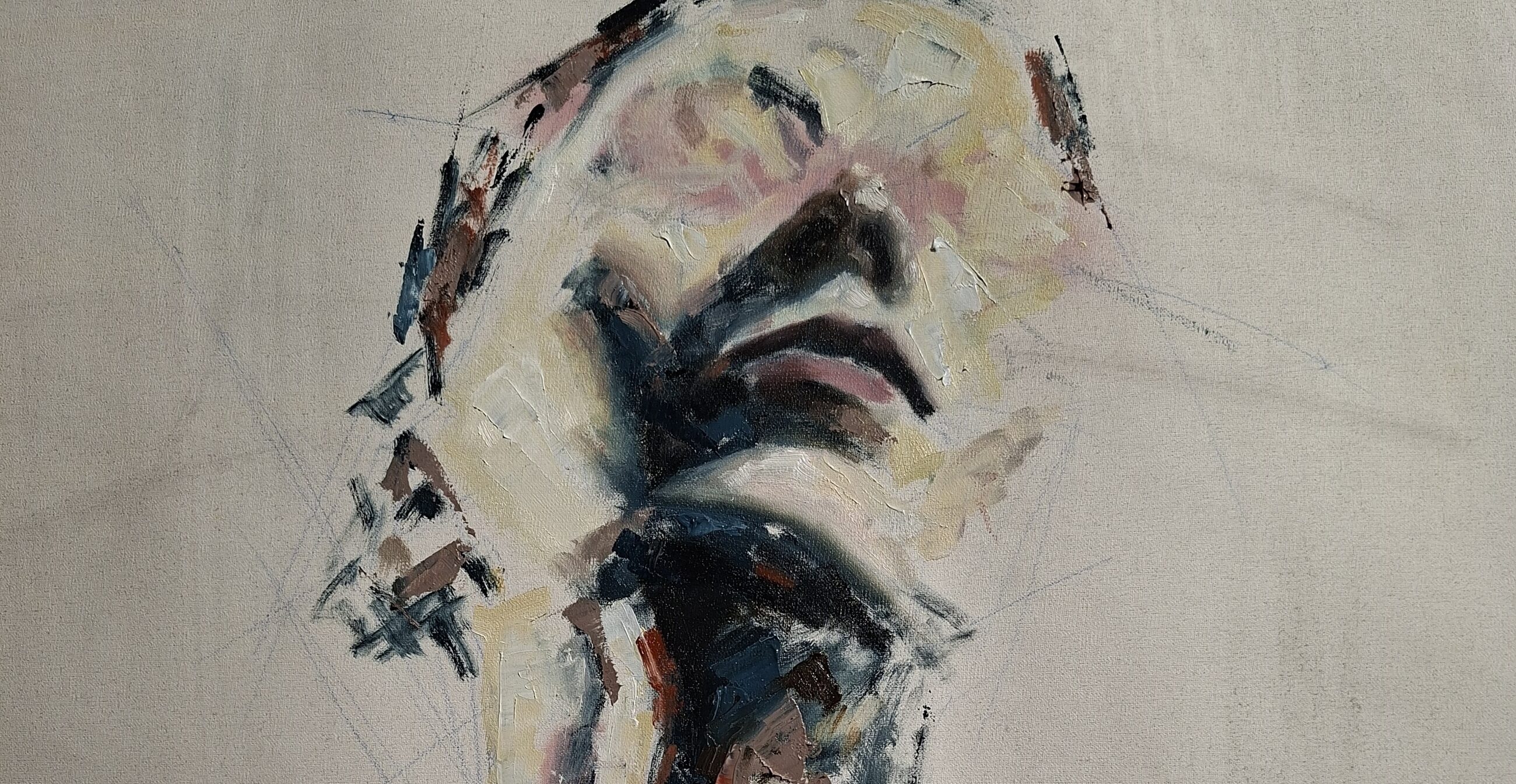
His paintings seem to possess an internal sound. They move. They rise and fall. They become quiet and then suddenly intense. They contain moments that feel almost like whispers and others that arrive with the force of an orchestral crescendo. This is why I have become interested in thinking about Schaefer not simply as a painter of faces and bodies, but as a composer of emotional states. His medium is oil rather than sound, his canvas rather than a concert hall, his pigments rather than instruments; yet the experience can feel strangely similar. I do not simply see the paintings. I seem to enter them, and once inside them, I discover that they have their own rhythm.
The more I think about this sensation, the more I realize that the metaphor of the symphony may reveal something fundamental about why Schaefer’s work affects me so strongly. A symphony is not created by one sound alone. It is created by relationships: between light and darkness, movement and stillness, tension and release, repetition and variation, presence and absence. Its emotional power emerges from the way individual elements become part of something larger than themselves. Schaefer’s paintings possess this same quality. A face is not merely a face; it is part of a larger emotional architecture. A dark area is not simply a dark area; it establishes a mood. An absence becomes a silence. A wound becomes a dissonant note. A delicate passage of paint becomes something like a quiet instrument entering the composition. Even the things that appear incomplete can feel necessary, because music itself would lose its power if every moment were filled with sound. Perhaps this is why his paintings do not leave me with a single, simple interpretation. They produce layers of feeling that arrive at different times. First comes attraction, then curiosity, then unease, then contemplation, and eventually something quieter that is difficult to name. I find myself thinking about the paintings after I have stopped looking at them. They continue somewhere inside me, as music sometimes continues after the final note has disappeared. The painting has ended visually, but it has not ended emotionally. It has become an echo.
THE FIRST MOVEMENT — ENTERING THE DARKNESS
Every symphony has an opening, and the opening determines the atmosphere into which the listener is invited. Before the themes are understood, before the emotional journey has revealed itself, there is a first sound that establishes the world. I experience Schaefer’s paintings in a similar way. Their darkness often arrives before their meaning. It is the first movement. Before I understand the figure, before I begin to think about the symbolism of the face or the psychological implications of the image, I feel the atmosphere. There is a gravity to the paintings, an emotional temperature that seems lower than ordinary life. The darkness is not merely the absence of light. It feels inhabited. It has weight, depth and texture. It creates a space in which the figure seems to emerge rather than simply stand. This reminds me of the way an orchestra can begin quietly, with a low instrument barely audible, creating tension before the listener understands what is coming. Schaefer’s darkness works similarly. It prepares the emotional ear of the viewer. It asks us to slow down. It removes the brightness and immediacy of ordinary visual experience and replaces it with something more inward. We are no longer simply looking at an object; we are entering a psychological space.
What fascinates me is that this darkness does not destroy beauty. Instead, it seems to make beauty more fragile and therefore more intense. A face emerging from darkness can feel more precious than a face placed in complete light. A small area of brightness becomes significant because the surrounding world is dark. This is one of the reasons I experience his paintings as musical rather than merely pictorial. In music, silence gives sound its meaning. A single note would not have the same emotional force if it existed without the surrounding silence. In the same way, light in Schaefer’s paintings seems to depend upon darkness. The darkness becomes the silence surrounding the note. It allows the smallest visual gesture to resonate. Perhaps this is also why the paintings can feel melancholic without becoming simply depressing. Melancholy is not pure darkness. It is the awareness that light exists, but that it is temporary. It is the knowledge that beauty can be encountered while simultaneously knowing that beauty cannot be permanently possessed. Schaefer’s paintings seem to understand this. They do not place beauty outside suffering; they allow the two to exist together. The result is a visual atmosphere that feels almost like a minor key: not without beauty, but beauty transformed by the knowledge of mortality.
RHYTHM IN THE BRUSHSTROKE — WHEN PAINT BEGINS TO MOVE
If the darkness is the opening movement, then the brushstroke becomes the rhythm through which the painting begins to move. A painting is physically still, but some paintings create an illusion of movement so strong that the eye travels across them almost involuntarily. Schaefer’s work can produce this sensation because the paint does not always behave as though it were merely filling in an image. The brush marks have their own energy. Some areas feel controlled and patient; others feel more immediate, almost instinctive. The difference between these passages creates rhythm. I begin to imagine the painting not as a frozen moment but as the record of time passing through the artist’s hand. Every mark contains a small history: a movement of the wrist, a decision, a hesitation, a correction, a moment of confidence, perhaps even a moment of uncertainty. The surface therefore becomes something like a musical score. We cannot hear the sounds that produced it, but we can feel their traces. The painting preserves the choreography of its own creation.
This is where the physicality of oil paint becomes important. Oil does not simply sit on the canvas as information. It has density. It can be transparent or opaque, thin or heavy, smooth or rough. It can create the sensation of skin, shadow, atmosphere, weight and depth. When these possibilities are arranged across a painting, they create something resembling orchestration. One passage can behave like a string instrument, delicate and sustained; another can have the force of percussion; another can disappear almost completely, like a sound fading into silence. The eye moves between these different visual registers, and this movement becomes emotional. I think this is one reason why Schaefer’s paintings can feel alive even when the figures themselves appear still or withdrawn. The movement has been transferred from the body of the subject into the body of the paint. The person may be silent, but the surface speaks through rhythm. The canvas becomes a record of an encounter between intention and instinct. And perhaps this is one of the deepest similarities between painting and music: both can communicate something that cannot be reduced to the literal meaning of their elements. A single brushstroke means very little in isolation, just as a single musical note can be almost meaningless without context. It is the relationship between marks that creates the emotional language.
THE FACE AS AN INSTRUMENT — THE HUMAN FIGURE AS MUSIC
At the centre of Schaefer’s visual world is the human face, and this is where the symphony becomes most intimate. A face is already a kind of instrument. It communicates without words. A slight movement of the mouth, a change around the eyes, a tension in the jaw, the direction of a gaze—these small changes can communicate entire emotional worlds. Yet Schaefer often interrupts this natural communication. The eyes may be hidden, damaged, absent or otherwise denied their ordinary function. This makes the face strangely similar to an instrument that has been altered. It is still recognizable, but it no longer produces the expected sound. The viewer looks for the normal signals of identity and emotion and discovers instead a silence. That silence is powerful. It makes the face mysterious. It prevents the figure from becoming completely readable. Instead of giving us an answer, Schaefer gives us an unresolved chord.
This is perhaps where I feel the deepest connection between his paintings and the idea of a symphony. Every great musical composition contains voices that do not simply repeat one another. They coexist. Sometimes they harmonize; sometimes they contradict each other; sometimes one disappears while another becomes dominant. Schaefer’s faces seem to contain this multiplicity. They can be beautiful and frightening, vulnerable and distant, human and almost unreal at the same time. The figure becomes a container for contradictory emotional frequencies. I look at a face and feel that I am seeing something intimate, yet I cannot identify exactly what it is. It is as though the painting has given me access to the outer edge of another person's interior world but refuses to let me enter completely. This refusal is important. In ordinary portraiture, the face can become an answer. In Schaefer, the face becomes a question. Who is this person? What happened to them? What are they thinking? What are they hiding? What has been lost? What remains? These questions become the music of the painting. They continue sounding precisely because they are not resolved.
DISSONANCE — BEAUTY THAT HURTS
Every symphony requires some form of tension. Without dissonance, harmony would lose its emotional meaning. Without darkness, light would become ordinary. Without sadness, happiness would lose its depth. Schaefer’s paintings understand this relationship instinctively. There is often something beautiful in them that is simultaneously difficult to look at. The beauty attracts the eye while the disturbance prevents comfort. This is what I would call the dissonance of his work. The paintings do not allow beauty to remain innocent. They place it beside damage, uncertainty or darkness, and the resulting tension becomes emotionally powerful. I find myself wanting to look and wanting to look away at the same time. That contradiction is not a weakness. It is the experience the painting creates.
Dissonance is often misunderstood as ugliness, but in music it is not necessarily an unpleasant sound. It is a sound that creates expectation. It makes the listener wait. It creates the feeling that something has not yet been resolved. Schaefer’s paintings operate in precisely this space. They often feel unfinished in the psychological sense, even when the painting itself is complete. Something remains unresolved. The viewer is left suspended between attraction and discomfort. I think this is where his work touches something profoundly human. Our own lives are full of unresolved chords. We love people we cannot completely understand. We carry memories that contradict one another. We can experience joy while grieving. We can be beautiful and broken at the same time. We can desire intimacy while fearing exposure. Human consciousness itself is dissonant. Perhaps Schaefer’s paintings feel psychologically true because they do not try to remove this contradiction. They allow it to remain. Their beauty hurts because it resembles life: beautiful precisely because it is temporary, vulnerable precisely because it can be lost.
 Artwork by
Paul Schaefer
SILENCE — THE MUSIC OF WHAT IS NOT THERE
If there is one element that makes the symphony metaphor particularly powerful for me, it is silence. We tend to think of music as sound, but silence is one of its most important materials. Without silence, there would be no rhythm, no anticipation, no tension and no emotional breathing space. Schaefer’s paintings contain their own silences. They exist in obscured eyes, empty spaces, ambiguous expressions and areas where the image refuses to explain itself. The missing element becomes strangely louder than the visible one. When I look at an obscured face, I begin to imagine what is hidden. The mind fills the silence with possibilities. The painting says less, and therefore I begin to hear more.
This is also where his work becomes philosophical. Silence is the space in which knowledge reaches its limit. There are things about another person that we cannot know. There are things about ourselves that remain inaccessible. There are experiences for which language is inadequate. Art often becomes most powerful precisely at this boundary. A painting can approach something that cannot be stated directly. Schaefer seems to understand this intuitively. His figures do not explain themselves. They remain partly closed. This can feel frustrating, but it can also feel respectful. The painting does not force another human being into complete transparency. It allows the figure to retain an interior life that belongs only to itself. In an age when everything seems expected to be explained, displayed and made immediately understandable, this refusal has almost an ethical dimension. Mystery becomes a form of dignity. The unknown is not necessarily a failure of communication. Sometimes the unknown is what protects the depth of the thing being communicated.
THE FINAL MOVEMENT — WHEN THE PAINTING CONTINUES INSIDE YOU
A symphony eventually ends. The orchestra stops, the hall becomes quiet, and yet the experience does not disappear immediately. Something remains in the listener—a final vibration, an emotional residue, perhaps a melody that continues internally even after the external sound has ceased. This is how I experience Schaefer’s paintings. Their influence does not necessarily happen only while I am looking at them. In some ways, it begins after I have stopped looking. An image remains in memory. A face returns unexpectedly. A certain darkness becomes associated with a particular emotion. A question that the painting created continues to exist without the painting physically being present. The artwork has crossed the boundary between external object and internal experience.
This may be the most powerful form of art: when the artwork stops being entirely outside us. Schaefer’s paintings seem capable of doing this because they do not offer themselves as simple visual conclusions. They leave something unresolved, and the unresolved element travels with the viewer. I find myself thinking about the people inside the paintings even though I do not know them. I wonder what happened before the moment represented, what might happen afterward, and what exists behind the damaged surface. The painting becomes a fragment of a larger emotional world. In this sense, Schaefer is not simply painting moments; he is creating echoes. Each painting feels like a passage from a composition whose beginning and ending I cannot hear. I encounter it in the middle. I listen to it for a while. Then I leave, carrying part of its unfinished music with me.
THE SYMPHONY OF THE HUMAN CONDITION
Perhaps the deepest reason I experience Paul Schaefer’s work as a symphony is that his paintings seem to understand human existence as something composed of simultaneous voices. We are never only one emotion. We are never simply happy or sad, strong or weak, visible or hidden. We contain contradictions that exist together without necessarily being resolved. We can carry love and fear in the same moment. We can want to be seen while desperately protecting what is private. We can feel connected to other people and profoundly alone. We can admire beauty while knowing that everything beautiful is temporary. Schaefer’s paintings give these contradictions a visual form. The face becomes the melody, the darkness becomes the harmony beneath it, the damaged areas become dissonance, the empty spaces become rests, and the entire canvas becomes an emotional composition. What I experience as “symphony” is therefore not simply a comparison between painting and music. It is a way of describing the complexity of being human that the paintings seem to contain.
There is also something deeply moving in the fact that this symphony has no sound. Nothing is actually playing when I stand before a Schaefer painting. There is no orchestra, no instrument, no vibration in the air. And yet I feel movement. This suggests that perhaps the music is not really inside the painting at all. Perhaps the painting activates something inside the viewer that was already capable of hearing. The artwork becomes a catalyst. It awakens memory, emotion, imagination and associations that were dormant. The painting does not tell me exactly what to feel; it creates the conditions in which feeling becomes possible. That is why two people can stand before the same image and experience entirely different internal music. One may hear grief. Another may hear violence. Another may hear tenderness. Another may hear silence. The painting is fixed, but the symphony changes according to the consciousness of the person who enters it.
This is also why I hesitate to define Schaefer's paintings too precisely. To define a symphony only by its individual notes would be to miss the experience of hearing it as a whole. In the same way, to reduce his paintings to darkness, damaged faces, psychological symbolism or cultural references would be to remove the very quality that makes them alive. Their meaning exists in the relationships between these elements. The painting is not the face, the darkness, the wound or the brushstroke individually. It is the tension between them. It is the space where they begin to resonate. And perhaps this is what I find most beautiful about his work: it does not demand that I solve it. It asks me to listen.
THE NOTE THAT DOES NOT END
When I first encountered Paul Schaefer’s paintings, I thought I was looking at paintings. I did not expect them to become an experience that would continue beyond the moment of looking. Yet the more I return to them, the more I feel that the correct language for what happens is not entirely visual. I feel rhythm. I feel tension. I feel pauses. I feel something like a melody appearing and disappearing before I can name it. The faces become voices without words. The darkness becomes the low register beneath everything else. The damaged eyes become silence. The brushstrokes become movement. The beauty becomes a fragile harmony that is constantly threatened by dissonance. And somewhere between all of these elements, the painting begins to breathe. It ceases to be merely something hanging on a wall and becomes something happening inside me. Perhaps that is why I cannot simply look at Schaefer’s work and walk away unchanged. The image enters memory differently from the way an ordinary image does. It becomes an atmosphere, and atmosphere has no clear border. It follows us.
I think this is what art can do at its most powerful: it can translate one human being's inner movement into another person's experience without requiring language. The artist begins with pigment, but the viewer receives something else. The material becomes emotional. The visible becomes invisible. The silent becomes audible. Schaefer may begin with a face, but what reaches me is something much less concrete: vulnerability, distance, beauty, mortality, mystery, longing and the strange loneliness of being conscious inside a body that can never completely reveal what exists within it. His paintings remind me that we spend our lives trying to see one another, and yet every human being remains partly hidden. Perhaps this is not a tragedy to be solved. Perhaps it is the condition that makes empathy, imagination and art possible. If we could completely know another person, there would be no mystery left to approach, no silence left to listen to, no music left to compose.
And so I return to the word that first seemed like only a metaphor: symphony. Paul Schaefer's paintings feel like symphonies because they contain more than one emotional voice, because they move between harmony and dissonance, because they use silence as deliberately as sound, because their individual elements become meaningful only through their relationships, and because their final note does not truly disappear when the experience ends. The painting remains somewhere beyond the canvas. It becomes a memory, a question, a sensation, perhaps even a quiet disturbance that returns unexpectedly. I may stop looking at the painting, but I do not necessarily stop hearing it. And perhaps this is the most beautiful paradox of all: the painting is silent, yet it continues to speak; it is still, yet it continues to move; it is an image, yet it becomes music. In the end, perhaps Schaefer does not paint a symphony at all. Perhaps he creates the conditions for one to begin inside the person who stands before his work. And when I leave, when the painting is no longer in front of me, when the room has become ordinary again, something remains — not an answer, not a conclusion, but a final note suspended somewhere in the darkness, still vibrating, still unresolved, still alive.
 Artwork by Paul Schaefer