The Emberland Wound: Pauline Lindberg and the Dark Grammar of Contemporary Existence
Pauline Lindberg’s work occupies the space between abstraction and memory, beauty and damage, presence and disappearance. Her paintings and sculptures are built from layers, fragments, erosion, and intense colour, creating surfaces that seem to carry the weight of something already lived through. Rather than offering clear narratives, her work evokes states of uncertainty, endurance, displacement, and transformation.
Within these surfaces, material becomes memory and colour becomes residue. Houses, windows, ladders, and fragmented forms appear like traces of an inner architecture—structures shaped by what has been lost, endured, or transformed. Lindberg’s practice moves through the darker territories of existence, where meaning is not immediately visible but buried beneath layers of experience. Her works feel less like images to be observed than spaces to enter: landscapes of what survives, what disappears, and what continues to burn beneath the surface.
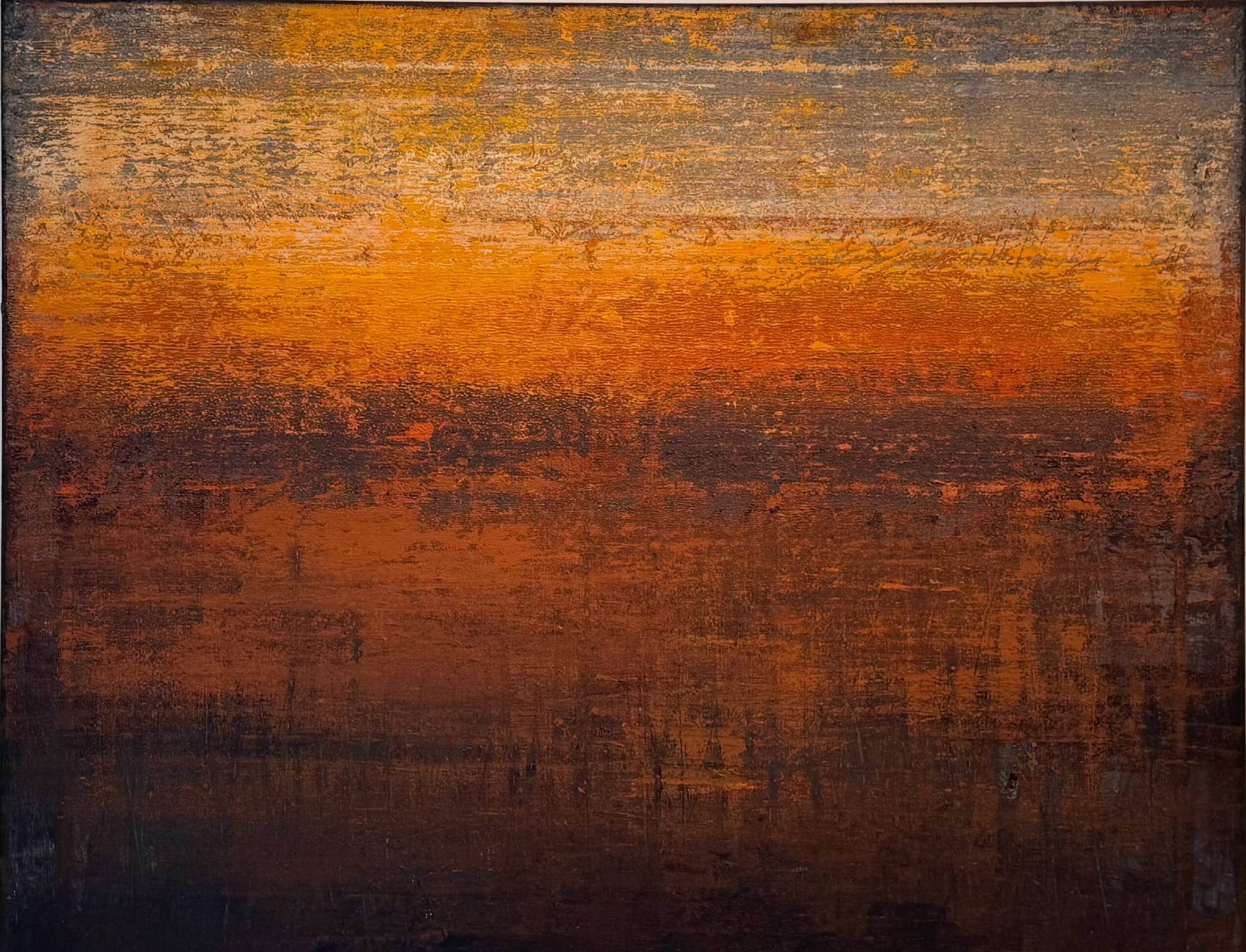
Pauline Lindberg’s art emerges from a place where light is not illumination but aftermath. Her canvases behave like surfaces that have survived something—heat, pressure, memory, time—and now carry the residue of that survival. She paints not to reveal but to expose what remains when revelation fails. In works like Into Emberland, the colour is not warm; it is scorched. The textures are not decorative; they are injuries. Her practice stands at the edge of abstraction and existential testimony, where the painter becomes a witness to the slow erosion of inner landscapes. Lindberg does not offer clarity. She offers depth, and depth in her world is always dark.
Her cultural position is shaped by displacement—born in New York, rooted in Sweden, suspended between two artistic climates that never fully reconcile. This tension becomes the engine of her work. The American influence brings industrial ruin, urban residue, and a sense of emotional abrasion. The Nordic influence brings silence, endurance, and the cold honesty of material. Together they form a visual language that is neither global nor local but liminal. Lindberg paints from the threshold, from the place where identity fractures into layers. Her surfaces are not abstractions; they are cultural sediments, compressed into a single burning field.
As a figure in the art world, Lindberg refuses the polished narratives that often accompany contemporary abstraction. She does not seek to soothe or to impress. She seeks to confront. Her studio in Hjärnarp is not a sanctuary but a crucible, a site where colour becomes ember and form becomes consequence. She works with tools that resist control—rollers, sponges, worn edges—because control is not the point. The point is friction. The point is the moment when material pushes back. To write about Pauline Lindberg is to write about an artist who understands that creation is inseparable from destruction, and that the most honest images are those that have survived their own making.
 Artwork by
Pauline Lindberg
Lindberg’s paintings operate as existential terrains. They are not landscapes but states of being, built from layers that behave like psychological sediment. The recurring motifs—houses, ladders, windows—are not symbols of hope or narrative. They are structures of confinement, escape, or rupture. A house becomes a memory that cannot be inhabited. A ladder becomes a failed ascent. A window becomes a boundary between what can be endured and what cannot. These elements drift through her work like remnants of a life that has been dismantled and reassembled in pigment.
Her dedication to materiality reveals a philosophy of resistance. Acrylic on linen becomes a site of conflict, a surface that must be worked through rather than worked on. She scratches, erodes, and forces pigment until the canvas behaves like earth. The surface becomes a scar. The colour becomes a wound. Lindberg’s method is not expressive; it is existential. She does not paint emotions; she paints the structures that contain them. Her canvases are built from the tension between intention and accident, revealing a painter who trusts the material more than the idea. The work speaks first; meaning arrives later.
Culturally, Lindberg’s art occupies a space between personal narrative and collective unease. Her works do not tell stories, yet they evoke the weight of histories—migration, silence, rupture, endurance. She understands that culture is not an external system but an internal pressure. Her paintings feel like artifacts from a civilization that exists only in the viewer’s memory. They demand engagement, not observation. To look at her work is to confront one’s own internal Emberland, the place where the self burns quietly beneath the surface.
Her sculptural practice deepens this existential vocabulary. The HER MESS series, with its illuminated resin forms and embedded fragments, behaves like archaeological evidence of a life lived under pressure. These sculptures are not objects; they are reliquaries of personal debris. They preserve what is fragile, discarded, or unresolved. Lindberg elevates the overlooked into significance, proving that identity is built not from clarity but from residue. Her sculptures reveal the same darkness as her paintings, but in three dimensions: the darkness of what remains.
 Artwork by Pauline Lindberg
As a person, Lindberg embodies the same qualities that define her work—intensity, honesty, and a refusal to simplify. She approaches painting as labor, not performance. Her studio practice is physical, relentless, and grounded in the belief that art must be earned through touch. She does not romanticize the process. She endures it. And through this endurance, she produces works that feel mythic, as if they were not created but unearthed. Her personality is not separate from her art; it is embedded in every layer of pigment.
In the broader art world, Lindberg occupies a position that is both peripheral and essential. She is not a trend follower; she is a world-builder. Her work resists the clean narratives of Scandinavian minimalism and instead offers a maximalism of feeling, a density of surface, a darkness of tone. She stands as a counterpoint to the polished aesthetics of contemporary abstraction, insisting that art must confront the complexity of existence rather than escape it. Her practice demonstrates that authenticity can be a form of defiance.
Her paintings challenge the viewer to reconsider what abstraction can hold. They are not exercises in form; they are confrontations with the aftermath of experience. The ember-like palette—rust, ochre, charred orange—suggests fire, but not destruction. It suggests transformation. Lindberg paints the residue of emotional events, the terrain left behind after something essential has burned. This makes her work profoundly human. It speaks to the quiet endurance that defines contemporary life, the way people carry their own emberlands within them.
Ultimately, Pauline Lindberg’s art is a testament to the power of darkness. Not darkness as negativity, but darkness as depth, as truth, as the place where meaning survives after clarity collapses. She has built a practice that is uncompromising, deeply personal, and culturally resonant. Her work reminds us that art is not a solution but a confrontation, not a decoration but a reckoning. She paints to understand what remains after the burning.

Artwork by Pauline Lindberg
The Dark Grammar of Endurance
Pauline Lindberg stands as an artist whose work cannot be consumed; it must be endured. Her Emberland is not a metaphor but a condition, a state of being that persists beneath the surface of contemporary life. Through her dedication to material, texture, and existential depth, she has created a body of work that feels both ancient and immediate, both personal and universal. Her paintings are not answers; they are remnants.
Her cultural significance lies in her refusal to offer comfort. In an art world obsessed with clarity, Lindberg embraces opacity. She understands that meaning is not given; it is excavated. Her work demands patience, introspection, and a willingness to confront one’s own internal architecture. She paints the structures of disappearance, the ladders that lead nowhere, the windows that open only inward. This is what makes her art essential: it reveals the truth that visibility is often born from darkness.
As a painter and as a person, Pauline Lindberg embodies the rare combination of discipline and fire. She works with the humility of a craftsperson and the severity of an existential thinker. Her art is not a career; it is a life lived through material. And through that life, she has carved a space in contemporary culture that will continue to burn long after the ember has cooled.
Art by Pauline Lindberg