
The cartographer of small mythologies
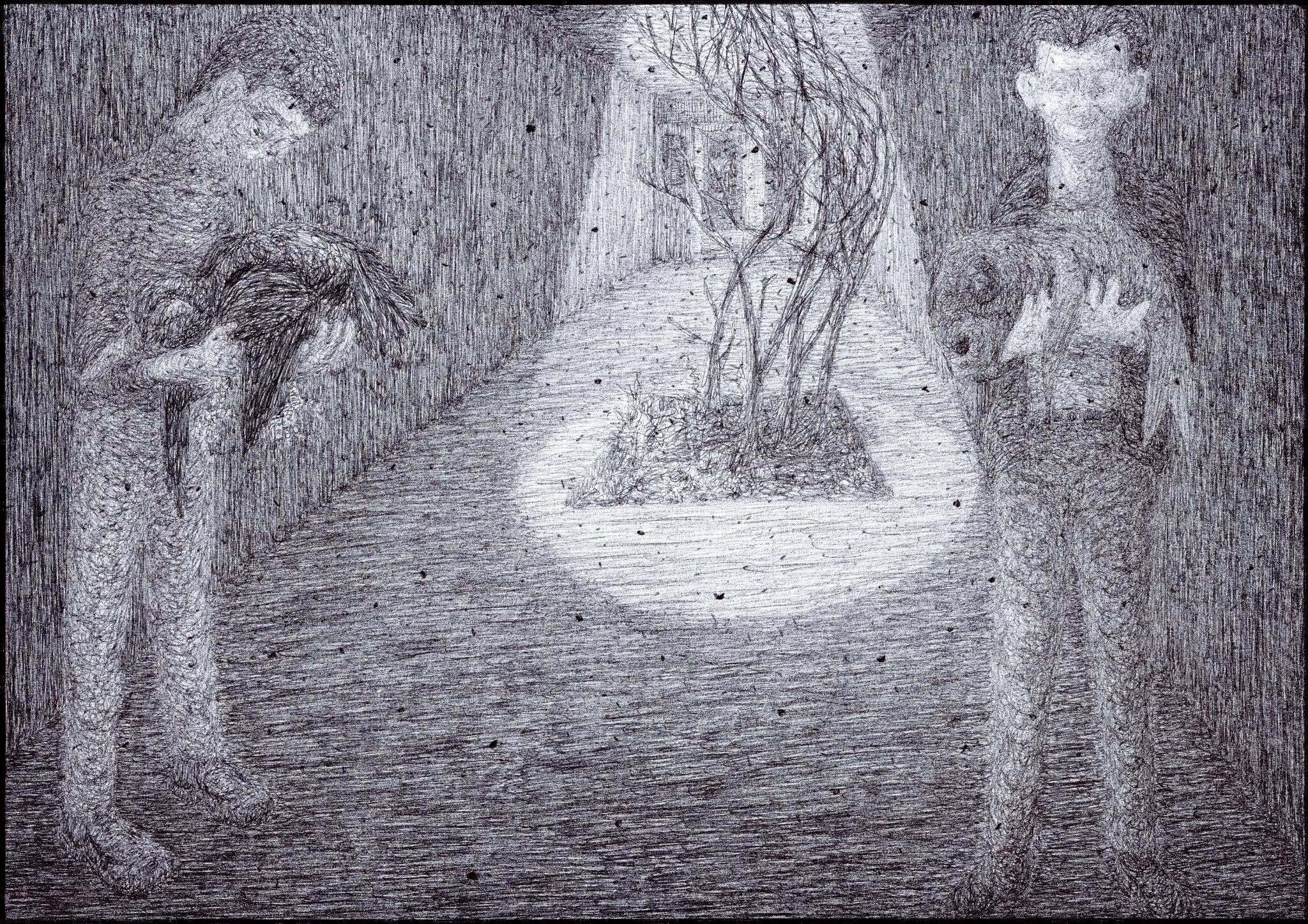
His biography reinforces this sense of continuity. Born in Tegelen in 1971 and living in Venlo, he has spent decades drawing and writing, building a universe that expands not through stylistic reinvention but through patient accumulation. Thousands of drawings, thousands of posts, thousands of small fragments — each one a tile in a mosaic of personal mythology. This persistence places him in a lineage of European draftsmen who use repetition as a form of devotion: Roland Topor with his grotesque ink worlds, Mœbius with his cosmic architectures, Štěpán Tesař with his melancholic surrealism. Yet Slaats stands apart. His world is neither grotesque nor cosmic nor political. It is interior, fragile, dreamlike — a private folklore unfolding in public view.
What makes his work compelling is the tension between simplicity and depth. The Bic pen suggests everydayness, office life, marginal notes. But Slaats hijacks this instrument and turns it into a myth‑engine. His drawings feel like pages torn from an unwritten novel, scenes from a story that continues beyond the frame. The line becomes a narrative device; the image becomes a chapter; the series becomes a cycle. In this way, Slaats does not merely draw — he writes with images. He composes visual literature. And his oeuvre, taken as a whole, reads like a multi‑volume saga of small mythologies.
 Artwork by Theo Slaats
Slaats’ style is defined by its refusal of virtuosity. His line is not flamboyant; it is patient. It repeats, accumulates, circles, builds. This repetition creates a rhythm that feels closer to handwriting than to illustration. The drawings resemble diary entries, intimate notations of inner states. In this sense, Slaats aligns with European draftsmen who treat drawing as a form of thinking — Walser’s microscripts, Schulz’s dreamlike prose, Topor’s absurdist visions. But unlike these figures, Slaats does not lean toward satire or grotesque distortion. His world is gentle, melancholic, and quietly enchanted. It is a world where imagination is not an escape but a habitat.
The serial nature of his work is crucial. Slaats does not produce isolated images; he produces cycles. The Poët-boy Dreaming, The Foresters, Boy and Bird, Mercy Island — each series functions like a literary structure. They are not projects; they are mythic ecosystems. Characters recur, motifs evolve, atmospheres shift. The Poët-boy appears again and again, always dreaming, always wandering, always suspended between childhood and artistic becoming. The Foresters guard their liminal woodland, figures of threshold and transition. The Boy and Bird form a dyad of self and otherness, a parable of companionship and estrangement. Mercy Island becomes a space of exile, refuge, or redemption. These cycles behave like chapters in a novel, each drawing a fragment of a larger narrative.
The Foresters series operates differently. It draws on mythic cycles found in European folklore — guardians of forests, mediators between human and wild, figures who inhabit the edges of civilization. These drawings feel like short legends, each one a vignette about coexistence with the non‑human world. The forest becomes a symbolic space: a place of danger, refuge, transformation. In this sense, Slaats participates in a long European tradition of woodland mythology, but he does so with minimalism rather than grandeur. His foresters are not heroic; they are contemplative. They are watchers, listeners, custodians of quiet.
 Artwork by Theo Slaats
The Boy and Bird series is perhaps the most allegorical. The relationship between boy and bird echoes literary parables — Saint‑Exupéry’s Little Prince, Rilke’s animal poems, Kafka’s creature stories. The bird becomes a symbol of freedom, message, soul, or otherness. The repeated pairing suggests a long conversation between self and alterity. Each drawing is a dialogue without words, a moment of recognition or misunderstanding. The boy does not dominate the bird; he accompanies it. The bird does not flee the boy; it observes him. Together they form a small myth of companionship that feels universal.
Mercy Island expands the scale. Islands in literature often signify isolation, experiment, or redemption — from Robinson Crusoe to modern exile narratives. Slaats’ island is not geographic; it is emotional. It is a place where judgment is suspended, where characters are tested or healed. The drawings feel like scenes from an unwritten novel, each one a glimpse into a world where mercy is both fragile and necessary. The island becomes a metaphor for the inner life — a place one retreats to, a place one must eventually leave, a place that shapes the self.
Across all these cycles, Slaats demonstrates a unique ability to merge drawing and writing. His texts are not captions; they are part of the visual fabric. They function like poetic fragments, echoes of the image, extensions of the narrative. This integration places him in a lineage of artist‑writers who blur the boundaries between disciplines — Topor, Schulz, Walser, Mœbius. But Slaats’ voice is distinct. It is quieter, more introspective, more concerned with tenderness than with irony or metaphysics. His work is not about explaining the world; it is about inhabiting it.
Ultimately, Slaats’ oeuvre can be understood as a lifelong attempt to map the territory between childhood imagination and adult consciousness. His drawings are waypoints on that map. His series are regions. His characters are guides. The Bic pen becomes a compass. And the entire body of work becomes a cartography of small mythologies — a visual literature that grows not through spectacle but through devotion, patience, and the quiet persistence of imagination.
 Artwork by Theo Slaats
His art world as meaningful experience
Feelings and powerful thoughts
The emotional force of Slaats’ work lies in its quietness. His drawings evoke solitude without loneliness, melancholy without despair, wonder without naivety. They invite powerful thoughts about vulnerability, imagination, and the fragile boundaries between self and world. The Poët-boy’s dreaming becomes a metaphor for the human condition — the perpetual oscillation between inner vision and outer reality. The Foresters remind us of the need for guardianship, not only of nature but of our own inner forests. The Boy and Bird teach us about companionship that does not demand possession. Mercy Island confronts us with the possibility of forgiveness. These feelings accumulate, forming an emotional architecture that lingers long after the image is gone.
The culture he represents
Culturally, Slaats represents a strand of European imagination that values introspection, myth, and the poetic everyday. His work echoes Dutch and broader European traditions of quiet symbolism, intimate storytelling, and the blending of reality with dream. He stands in contrast to the dominant cultural narratives of speed, noise, and digital spectacle. Instead, he embodies a culture of slowness, tenderness, and mythic continuity — a culture where small stories matter, where inner worlds are worthy of exploration, where imagination is a form of resistance. In this sense, Slaats is not only an artist but a cultural custodian, preserving a mode of seeing that is increasingly rare.
 Artwork by Theo Slaats
EPILOGUE: THE LINE THAT REMEMBERS
Theo Slaats’ art endures because it refuses to shout. It whispers. It invites. It builds worlds slowly, through repetition and tenderness. In an era of digital acceleration and visual overload, his drawings feel like acts of resistance — a return to slowness, to intimacy, to the quiet labor of imagination. His mythologies are not grand; they are small. But they are persistent. And in their persistence, they become profound.
His place among European draftsmen is defined not by influence or ambition but by devotion. He draws because drawing is how he thinks, how he remembers, how he dreams. His characters — the Poët-boy, the Foresters, the Boy and Bird — are not symbols of a theory; they are companions in a lifelong journey. They evolve as he evolves. They dream as he dreams. They inhabit the spaces between reality and imagination, between childhood and adulthood, between solitude and connection.