The fractured human harmony: a monumental study of Yoon's painting and cultural wold
2026 m. spal. 13 d. 12:03,
Komentarų nėra
A Painter of Fragmented Wholeness
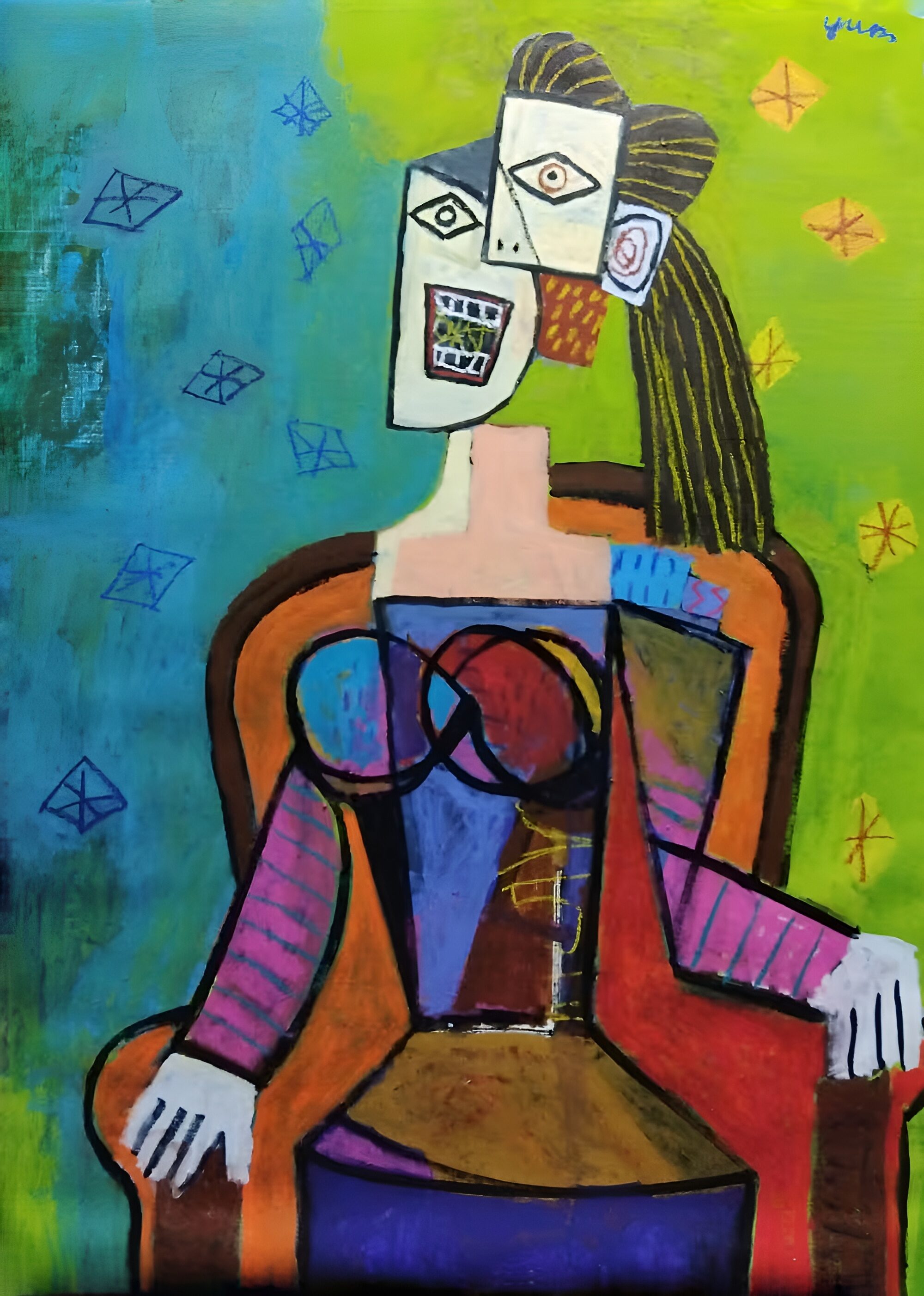
Yoon’s painting world is built on a paradox: his figures are visibly fragmented, yet they radiate a strange, undeniable wholeness. At first glance, his works confront the viewer with angular faces, broken planes, and bodies that seem assembled from shards of geometry rather than flesh. But as the eye lingers, the fragmentation reveals itself not as destruction, but as construction—a deliberate re‑building of the human form from multiple emotional and cultural layers. This is the key to understanding his art: Yoon does not paint people as they appear; he paints people as they are inside, as complex constellations of feelings, memories, tensions, and cultural influences.
His visual language is rooted in cubism, yet it is not a mere homage to Picasso or Braque. Instead, Yoon takes the cubist principle of breaking the object into planes and transforms it into a psychological and cultural method. The human figure becomes a site of analysis, a field where identity is dissected and reassembled. The result is a painting style that feels both modern and timeless, both deeply personal and universally resonant. In his world, the face is not a surface; it is an architecture.
The Geometry of Emotion: Structure as Inner Life
The most striking feature of Yoon’s paintings is the way geometry becomes emotion. His figures are composed of triangles, rectangles, trapezoids, and irregular polygons, all locked together by thick, assertive outlines. These shapes are not arbitrary; they function like emotional units. A sharp angle can suggest tension or anxiety; a broad plane can evoke calm or resignation; a narrow sliver of color can feel like a hidden thought or suppressed feeling. The entire figure becomes a diagram of inner life, where each geometric fragment corresponds to a psychological fragment.
This approach places Yoon in a lineage of artists who use structure to express emotion rather than merely to organize space. There is an echo of the Bauhaus belief in the expressive power of basic forms, but Yoon pushes this further: his geometry is not neutral; it is charged. The way planes intersect around the eyes, the way the nose is reduced to a sharp wedge, the way the mouth is compressed into a narrow band—all these decisions create a sense of emotional pressure. His figures often look as if they are holding something in, as if their fragmented faces are barely containing a storm of feelings.
Yet there is no chaos. The composition is always controlled, balanced, and carefully orchestrated. This tension between emotional intensity and structural discipline is one of the deepest qualities of his art. It suggests a worldview in which inner turmoil is real and powerful, but it is not allowed to dissolve the self. The human being, in Yoon’s paintings, is a fragile but resilient architecture, constantly negotiating between breakdown and coherence.
Color as Psychological Architecture
If geometry is the skeleton of Yoon’s figures, color is their blood. His palette is saturated, bold, and unapologetically expressive. He does not seek subtle gradations or atmospheric softness; he chooses colors that confront the viewer directly. Reds, blues, yellows, greens, oranges, and purples collide and coexist within the same face, the same torso, the same background. This chromatic intensity is not decorative; it is psychological.
Red in his work often appears as a force of urgency—anger, passion, danger, or raw vitality. Blue can function as introspection, melancholy, or distance. Yellow frequently acts as a disruptive element, injecting nervous energy or mental brightness that borders on anxiety. Green sometimes stabilizes the composition, offering a sense of grounding or organic calm amid the tension. The key is that these colors are not isolated; they are juxtaposed. Yoon rarely allows a single emotional tone to dominate. Instead, he creates color conflicts, visual dialogues between emotional states.
This chromatic strategy places him in conversation with Expressionism, where color is used to reveal inner states rather than external reality. But Yoon’s difference lies in his structural rigor. Unlike the wild brushwork of many expressionists, his colors are contained within geometric boundaries. They do not spill; they are held. This creates a powerful effect: the viewer feels the emotional intensity, but also senses the effort to control it. The painting becomes a metaphor for the human psyche—full of clashing feelings, yet constantly trying to maintain form.
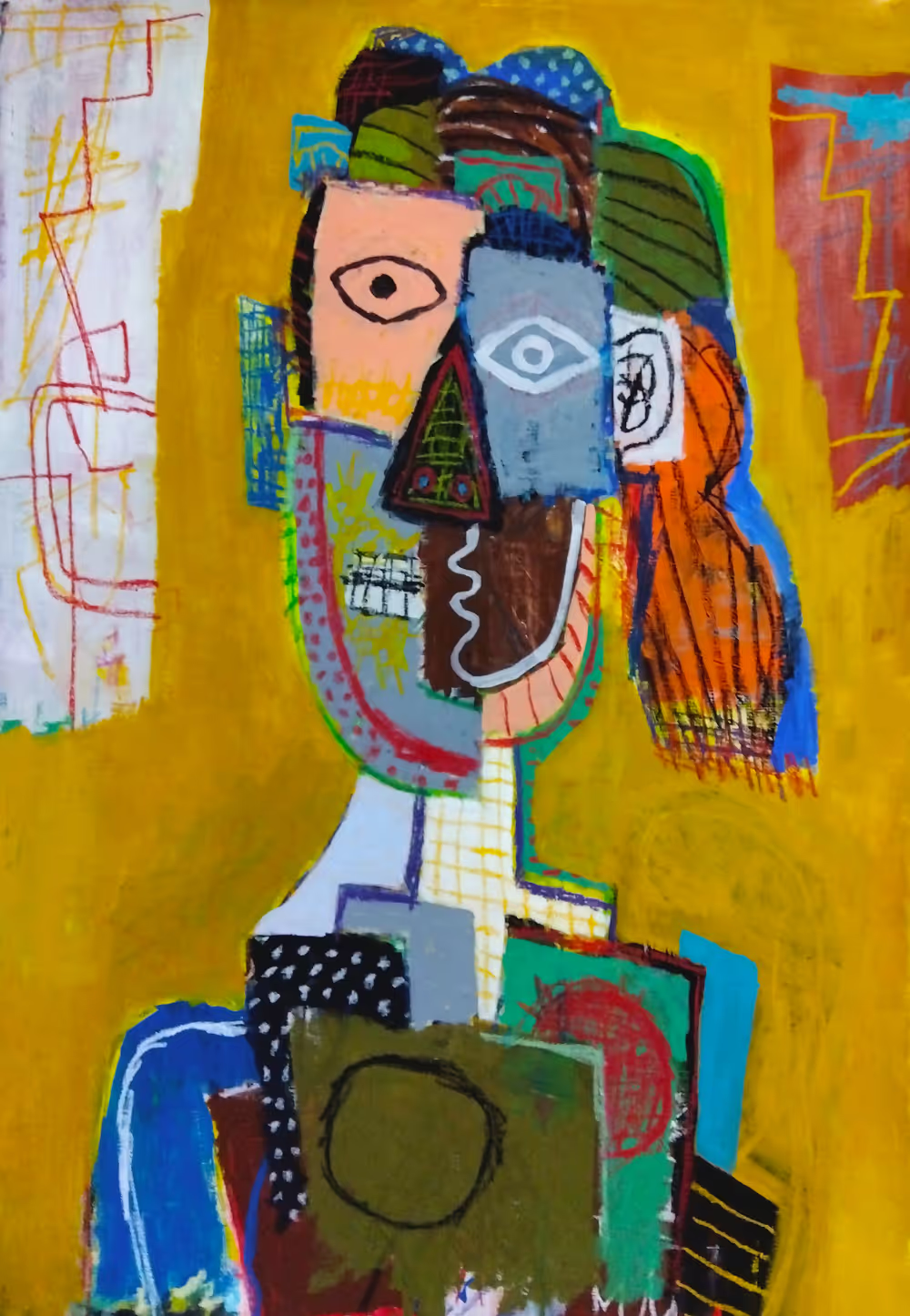 Artwork by Yoon
The Mask and the Face: Cultural Echoes of Identity
One of the most profound aspects of Yoon’s art is the way his faces oscillate between being human and being mask‑like. The eyes are often asymmetrical, the nose reduced to a wedge, the mouth compressed or stylized. The result is a face that feels both personal and symbolic, both individual and archetypal. This duality connects his work to a long cultural tradition in which the mask is used to express truths that the ordinary face cannot.
Historically, cubism drew heavily from African masks, which offered a way to break the human face into stylized, powerful forms. In Japanese culture, Noh masks and other theatrical traditions use abstraction to convey complex emotional states. Yoon’s faces seem to stand at the crossroads of these influences. They are not literal masks, but they carry the mask’s function: to reveal inner truth through stylization rather than through realistic depiction.
In his paintings, the mask‑like face becomes a symbol of modern identity. We live in a world where the self is constantly performed, curated, and presented to others. The face is no longer just a natural feature; it is a stage. Yoon’s figures embody this condition. Their faces are constructed, assembled, designed. They are not simply shown; they are built. This suggests a cultural insight: identity today is not given; it is made, negotiated, and often fragmented. The mask in his work is not a lie; it is a complex truth.
The Cultural Atmosphere: Tokyo and the Rhythm of Modernity
Even without explicit cityscapes or landmarks, Yoon’s paintings carry the atmosphere of Tokyo—a city where tradition and modernity coexist in a dense, pulsating rhythm. The structural clarity of his compositions echoes Japanese design principles: respect for line, balance of space, and the importance of form. At the same time, the intensity of his colors and the crowded feeling of his planes evoke the sensory overload of urban life: crowded trains, neon signs, overlapping advertisements, and the constant flow of people.
This cultural context matters because it shapes the emotional tone of his work. His figures do not exist in a quiet, isolated world; they feel like inhabitants of a complex, layered environment. The fragmentation of their faces can be read as a response to the fragmentation of modern urban experience—multiple roles, multiple pressures, multiple identities. The harmony of his compositions, however, suggests that he is not painting despair. He is painting adaptation: the way human beings learn to live within complexity without losing themselves entirely.
Tokyo is also a place where ancient aesthetics—calligraphy, woodblock prints, traditional theater—coexist with contemporary visual culture—manga, anime, graphic design. Yoon’s work seems to absorb this duality. His structural discipline recalls the clarity of traditional Japanese art, while his bold colors and stylized figures resonate with the energy of contemporary visual media. The result is a painting style that feels deeply rooted in a specific cultural atmosphere, yet open to global influences.
Fragmentation as Cultural Condition, Not Mere Style
It would be easy to describe Yoon’s art simply as “cubist” and leave it at that, but such a label would miss the deeper cultural meaning of his fragmentation. In his work, breaking the figure into planes is not just a formal device; it is a statement about the human condition. We live in a time where identity is no longer singular. People move between languages, cultures, social roles, and emotional states. The self is not a solid block; it is a mosaic.
Yoon’s paintings visualize this mosaic. Each fragment of the face, each block of color, each angle of the body represents a different aspect of the person—social role, emotional state, cultural influence, private memory. The figure is not broken; it is composed. This is crucial: his art does not lament fragmentation as loss. Instead, it presents fragmentation as reality and, in a way, as richness. The human being in his work is complex, layered, and multifaceted. The painting becomes a map of complexity, not a picture of ruin.
This perspective has profound cultural implications. It suggests that modern identity, though fractured, is not doomed. It can be held together by structure, by art, by consciousness. The thick outlines in his paintings can be read as the boundaries of selfhood—the lines we draw to keep our fragments from scattering. His art thus becomes a meditation on how we remain whole in a world that constantly pulls us apart.
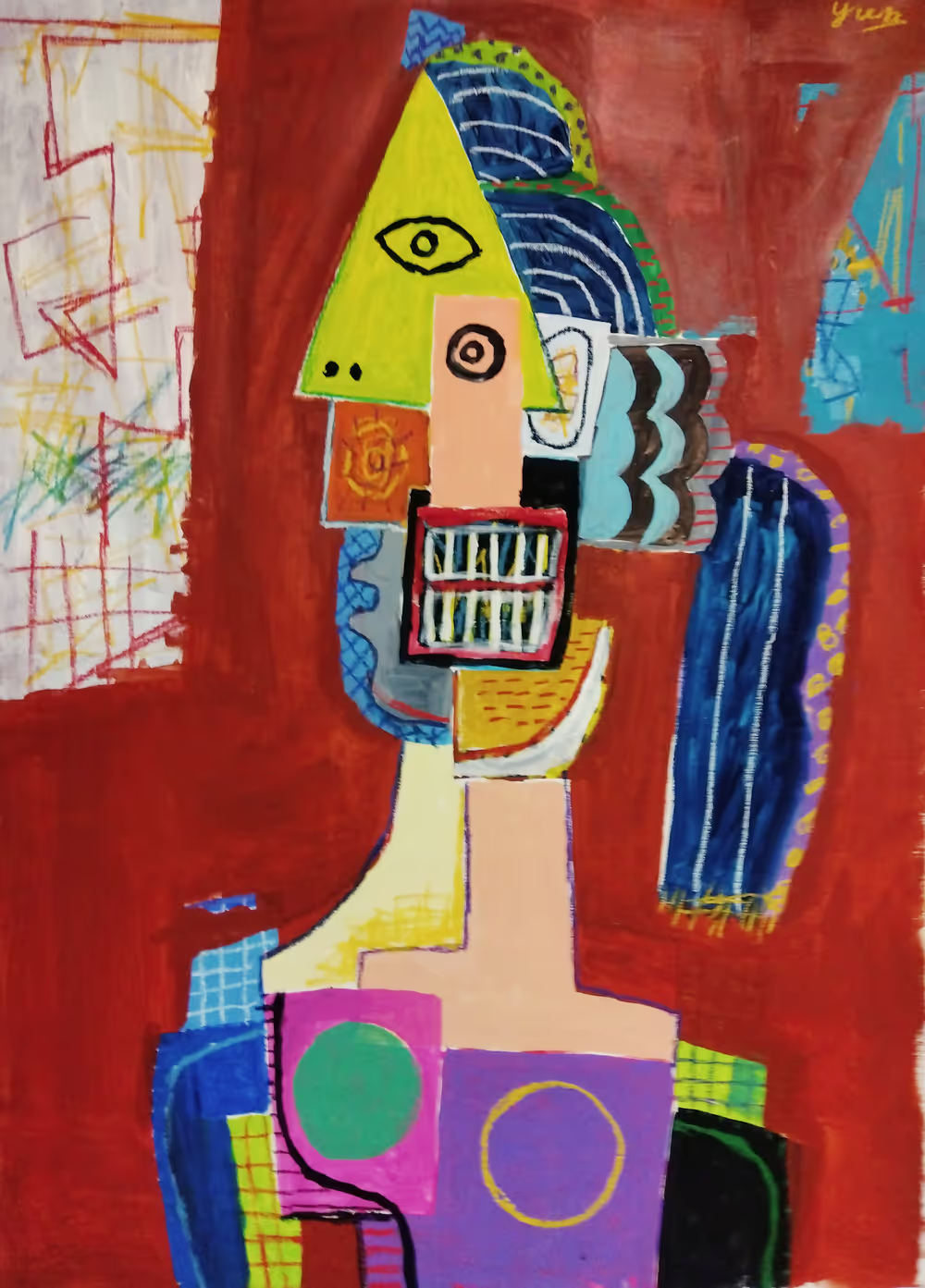 Artwork by Yoon
The Tension Between Order and Turbulence
One of the most profound aesthetic tensions in Yoon’s work is the interplay between order and turbulence. On the one hand, his compositions are carefully balanced. The distribution of shapes, the rhythm of lines, the placement of colors all reveal a strong sense of control. On the other hand, the emotional content of the paintings is intense, sometimes almost overwhelming. The faces look strained, the eyes unsettled, the colors clashing.
This tension is not accidental; it is the core of his vision. Yoon seems to be saying that human life is always lived between these two poles: the desire for order and the reality of turbulence. We build structures—mental, emotional, cultural—to contain our chaos, but the chaos never disappears. In his paintings, the geometry is the structure, and the color is the turbulence. The two coexist, neither fully dominating the other.
This coexistence gives his work a profound psychological depth. The viewer senses that these figures are not at peace, but they are not collapsing either. They are holding themselves together. The painting becomes a visual metaphor for resilience: the ability to remain coherent even when one’s inner world is full of contradictions. This is not a sentimental message; it is a hard, honest one. Yoon’s art does not offer easy harmony; it offers earned coherence.
The Silent Narratives of His Figures
Although Yoon’s paintings are not narrative in the traditional sense—there are no explicit scenes, no clear stories—they are full of silent narratives. Each figure seems to carry a history, a set of experiences that have shaped its fragmented form. The tilt of the head, the direction of the gaze, the compression of the mouth, the tension in the shoulders—all these elements suggest emotional stories: fatigue, defiance, contemplation, vulnerability.
The absence of literal narrative elements (no background scenes, no objects that tell a story) forces the viewer to read the figure itself as the story. The body becomes the text. This is a deeply modern approach to narrative: instead of depicting events, the artist depicts their psychological consequences. Yoon’s figures are not doing anything; they are being—being complex, being tense, being layered. Their very form is the narrative.
This approach aligns with a broader cultural movement in which the focus shifts from external events to internal states. In literature, cinema, and art, there is a growing interest in the inner life, in the invisible dramas of thought and feeling. Yoon’s paintings participate in this movement by making inner complexity visible through form and color. His figures are not characters in a story; they are stories condensed into faces.
The Spiritual Dimension: Fragmentation and Unity
Beneath the psychological and cultural layers of Yoon’s work lies a subtle spiritual dimension. His paintings, despite their tension and fragmentation, often convey a sense of quiet dignity. The figures do not appear defeated. They stand, they look, they exist with a certain gravity. This suggests that, for Yoon, the human being is more than the sum of its fragments.
The geometry in his work can be read not only as analysis but also as a search for underlying order. The way shapes fit together, the way colors balance each other, the way the composition holds—all these elements hint at a belief that there is some kind of unity beneath the surface complexity. The painting becomes a ritual of assembling, a visual act of bringing fragments into relation. In this sense, his art has a spiritual undertone: it is about the possibility of unity in a fractured world.
This does not mean that his work is religious in a doctrinal sense. Rather, it is spiritual in the way it treats the human figure with seriousness and respect. The fragmented face is not mocked or trivialized; it is honored as a site of struggle and meaning. Yoon’s paintings invite the viewer to contemplate the mystery of being a person—broken and whole at the same time.
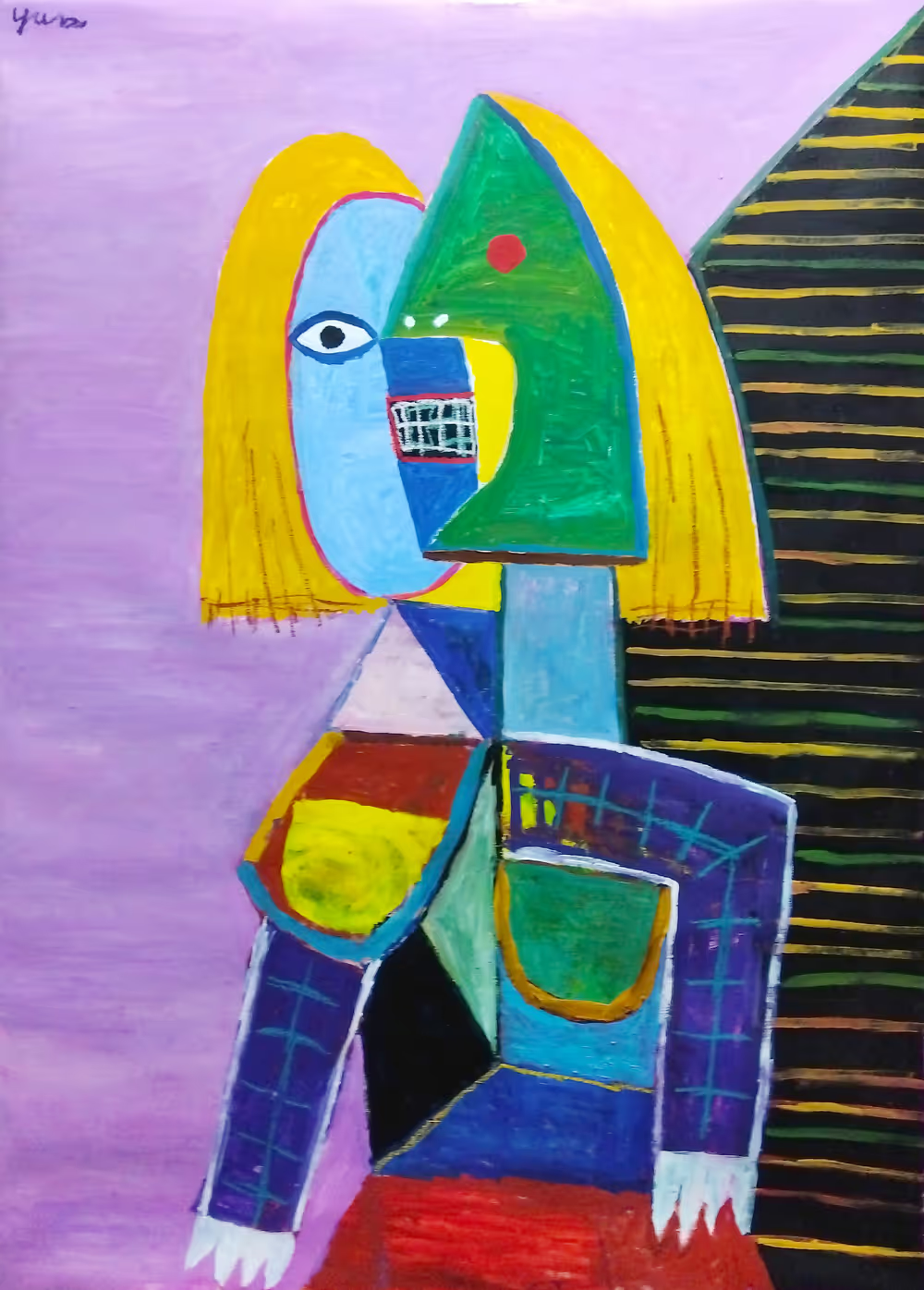 Artwork by Yoon
Yoon’s Place in Contemporary Painting
Within the broader landscape of contemporary painting, Yoon occupies a distinctive position. Many painters today either pursue hyper‑realism, abstract minimalism, or conceptual strategies that distance the viewer from emotional immediacy. Yoon, by contrast, embraces emotion, structure, and the human figure all at once. He does not abandon the body; he interrogates it. He does not reject form; he intensifies it. He does not flee from feeling; he encodes it in geometry and color.
His work can be seen as part of a renewed interest in figuration, but it is figuration transformed by the lessons of modernism. He has absorbed cubism, expressionism, and design principles, and then forged them into a personal language that speaks to the present. In this sense, Yoon is not a nostalgic modernist; he is a contemporary painter who uses modernist tools to address contemporary questions: What does it mean to be a person now? How do we live with complexity? How do we remain whole when everything around us is fragmented?
His answer is not verbal; it is visual. He shows us figures that are broken and yet standing, tense and yet composed, saturated with color and yet held by line. In doing so, he offers a powerful image of modern humanity—one that is neither idealized nor despairing, but truthful and dignified.
Final Synthesis: The Culture Inside the Face
If we try to condense the profound cultural and artistic meaning of Yoon’s work into a single idea, it might be this: the culture of our time lives inside the face. In his paintings, the face is not just a physical feature; it is the place where history, society, emotion, and identity converge. Every fragment of color, every angle of geometry, every asymmetrical eye is a trace of the world that has shaped that person.
Yoon’s art shows that culture is not only outside us—in cities, institutions, media—but also inside us, in the way we feel, think, and hold ourselves together. His figures are cultural beings, not in the sense of wearing costumes or standing in recognizable settings, but in the deeper sense of embodying the tensions, contradictions, and possibilities of contemporary life. The culture he paints is one of fragmentation and resilience, complexity and structure, turbulence and form.
In this way, Yoon’s painting is both intensely personal and broadly cultural. It speaks of individual inner worlds, but it also speaks of the shared condition of living now. His art is not a commentary from the outside; it is a visual experience from within. To look at his paintings is to look at a mirror that does not show our surface, but our architecture.