
The Anatomy of the Absolute: Matter, Metaphysics, and the Monumental Abyss
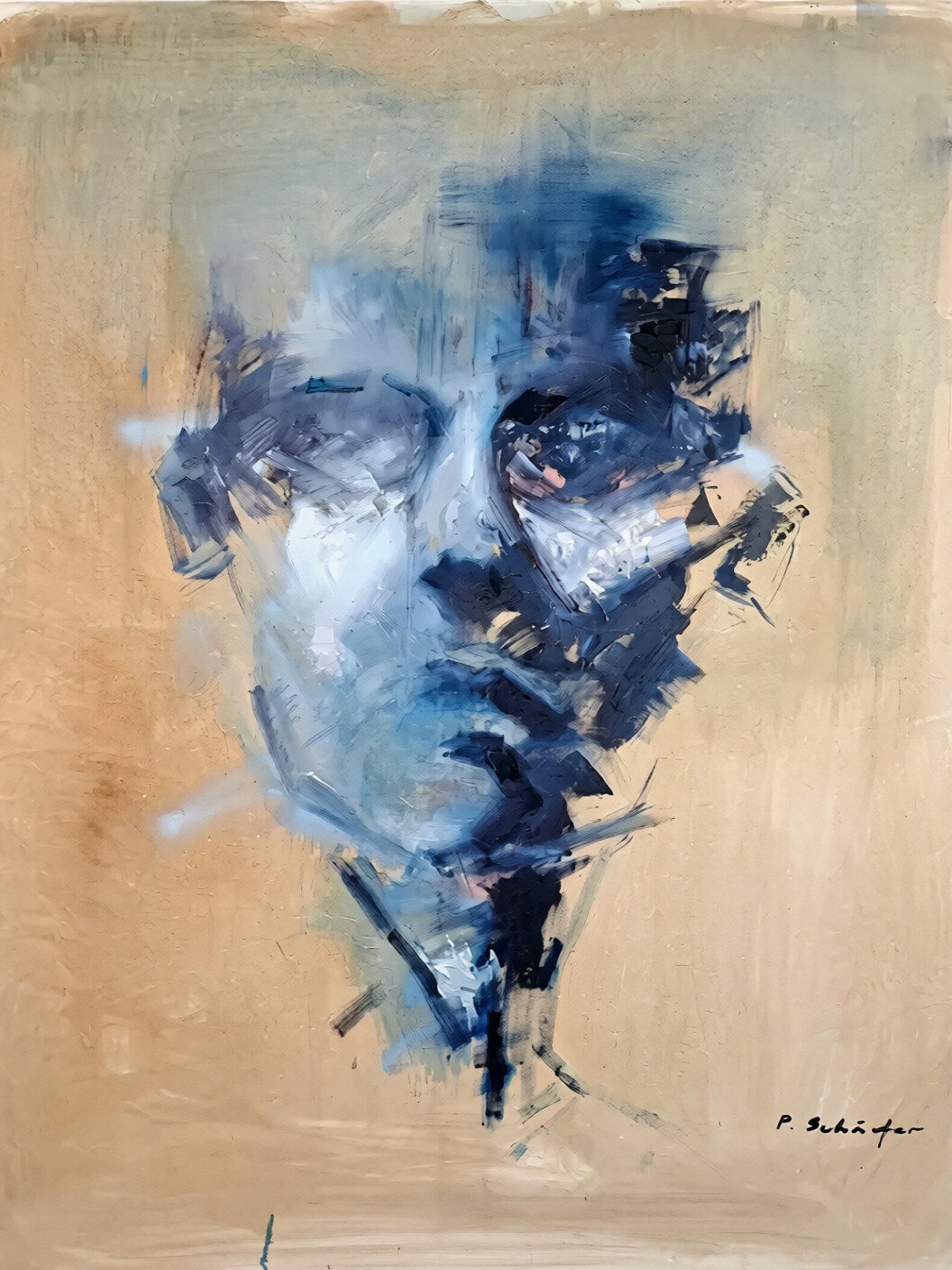
Note on the Epistemological Shift: The transition from psychological introspection to a monumental ontological framework requires an abandonment of narrative comfort, forcing the viewer to confront the artwork not as a window to look through, but as a dense wall to collide against.
The Tectonic Paradigm: Every layer of pigment operates as a geological stratum, wherein the painting absorbs the historical burden of its own creation, burying old truths to give birth to new, harsher structural realities.
Furthermore, this totalizing framework demands that we abandon any lingering nostalgia for narrative clarity or psychological comfort, treating the pictorial field as an uncompromising metaphysical battlefield. The artist constructs an environment where every brushstroke is an act of existential defiance, weaponizing raw pigment against the encroaching tide of meaninglessness and modern dissolution. Here, the canvas does not invite passive contemplation; it demands total surrender to a harsh, unyielding truth that strips away all illusion and leaves the viewer exposed before the naked machinery of being.
The Metaphysical Battlefield: Every application of paint functions as a strategic entrenchment, turning the canvas into a site of permanent conflict between form and annihilation.
The Stripping of Illusion: All decorative pretense is systematically burned away, leaving an unvarnished confrontation with the raw, brutal mechanics of human consciousness and material reality.
The Stratigraphy of Time and Material Memory
What strikes one with overwhelming, visceral force in this mature phase of the painter's work is the uncompromising handling of surface as a physical, unyielding record of geological time. Pigments, heavy layers, aggressive scrapes, and dense textural deposits do not simply build an illusory image; they construct physical strata that mirror the earth's crust, preserving the fossilized memory of ancient cataclysms, discarded compositions, agonizing hesitations, and sudden, violent breakthroughs. To look closely at the work is to practice a rigorous form of vertical reading, where every single brushstroke functions simultaneously as an act of burial and an act of exhumation, entombing the past while dragging it kicking and screaming into the present tense. The surface breathes with a heavy, labored respiration because it carries structural weight—the profound weight of historical consciousness and personal excavation—refusing the superficial slickness of contemporary image production in favor of an authentic, scarred materiality. Here, time is never linear or progressive; rather, it is radically compressed into a single, dense, suffocating present where the initial genesis of the painting and its final, brutal completion coexist in a state of permanent, unresolved tension. The artist forces the viewer to confront the inescapable materiality of existence, reminding us that things endure and command authority not because they are pristine or untouched by decay, but precisely because they have survived the violence of erasure and the erosion of time.
The Archaeology of the Brush: Pigment is never treated as a translucent veil, but as a heavy, opaque mass that records physical resistance, human labor, and the stubborn persistence of form against destruction.
Temporal Collapse: The linear chronology of the creative act is obliterated, fusing the first chaotic stroke with the final resolving cut into a single, eternal, and simultaneous moment of visual truth.
Moreover, this accumulation of physical strata transforms the painting into a literal archive of human suffering and perseverance, where each buried layer serves as a testament to battles fought and lost beneath the surface. The scars left by the scraper and the knife are not accidental blemishes, but essential scars of survival that map the psychological toll of creative endurance across years of unyielding labor. By forcing these historical layers to violently coexist in the present tense, the artist bypasses mere narrative representation and achieves a monumental presence that outlasts the temporary fluctuations of cultural fashion.
The Archive of Perseverance: Each embedded layer and structural scar functions as a physical logbook of psychological endurance, recording the silent battles fought beneath the finished surface.
Immunity to Fashion: By anchoring the work in the harsh materiality of layered time, the artist creates a timeless monument that entirely transcends the ephemeral trends of contemporary art.
The Anatomy of the Abyss and Spatial Gravity
If earlier works played with the emotional dualities of internal landscapes, this monumental phase confronts the austere, terrifying anatomy of the abyss with uncompromising rigor. The spaces that exist between figures, structural lines, or dense color fields are never empty or passive; instead, they operate as heavily charged fields of magnetic potential, pressing inward with the crushing force of a vacuum. In classical composition, negative space typically serves as a resting place or a visual breather for the eye, but in this monumental syntax, the abyss is an active, predatory protagonist that threatens to swallow the fragile human forms whole. The forms themselves do not submit easily; they stubbornly resist this atmospheric dissolution, asserting their defiant presence through sheer chromatic intensity and tactile, muscular force. This dynamic tension is precisely what grants the work its massive, monumental scale, demonstrating that monumentality has nothing to do with physical dimensions or wall size, but is entirely a measure of psychic and spatial gravity. A relatively small canvas can possess the structural weight and spiritual gravity of a medieval cathedral because it captures the fundamental, unresolvable conflict between human finitude and infinite, indifferent space. The painter builds rigorous frameworks of order—geometric hints, structural rhythms, and sharp anchor points—only to watch them deliberately dissolve into atmospheric chaos, staging a perpetual cosmic drama of creation, order, entropy, and dissolution.
The Active Abyss: Negative space is re-engineered from a passive background into an aggressive, compressive force that tests the structural integrity of every painted element.
Scale as Psychic Weight: Monumentality is divorced from physical scale, emerging instead from the density of internal conflict, spatial pressure, and the unyielding gravity of the composition.
Furthermore, this relentless confrontation with spatial gravity strips away all comforting illusions of human centrality, placing the viewer on the precipice of an infinite, vertiginous void. The tension between the rigid structural grids and the chaotic, swallowing depths creates an unbearable psychological pressure, forcing the spectator to acknowledge the profound fragility of order in a universe defined by entropy. It is precisely within this harrowing gap—where form desperately clings to existence against the pull of total dissolution—that the true, monumental power of the painting is forged.
The Decentering of Man: The terrifying scale of the abyss strips away human vanity, forcing an immediate reckoning with our absolute insignificance before the infinite.
The Triumph of Precipitous Form: Monumental power is located entirely in that razor-thin margin where structural order successfully resists being swallowed by total entropy.
The Transfiguration of the Fragment and Aesthetic Resistance
We have previously spoken of the broken face and the silent symphony as expressions of psychological alienation or internal, unvoiced harmony, but when viewed through the lens of this broader philosophical synthesis, those fragments are revealed as parts of a higher, transfigured totality. The painter does not lament the shattering of traditional, harmonious forms or the loss of a unified classical ideal; instead, they celebrate the generative, explosive power of the fragment as the only honest mode of expression left to us. In a world fractured by historical trauma, technological dislocation, and spiritual alienation, a unified, seamless image would be an intolerable falsification, a comforting lie designed to mask a broken reality. By aggressively embracing the rupture—the sharp cut, the brutal blur, the asymmetrical imbalance, and the deliberate discord—the artist achieves a higher, more rigorous order of truth. The fragmented image is thus elevated into an icon of radical human resilience, suggesting that meaning is never something given to us intact from the outside, but is rather something we must continually piece together, defend, and re-articulate from the ruins of our own perceptions. This aesthetic of resistance transforms the canvas into a battleground where the human spirit refuses to be erased by the vast, silent machinery of the universe, standing as an enduring testament to the power of form to conquer chaos.
The Aesthetics of Rupture: Fragmentation is reclaimed not as a failure of wholeness, but as a necessary, truthful response to a fractured world that demands authentic, uncompromised witness.
The Icon of Resilience: The artwork functions as an enduring monument to human agency, proving that meaning can be forged out of the very debris of historical and psychological destruction.
In addition, this intentional fracturing elevates the canvas from a private confession into a universal testament of our fractured historical epoch. By refusing to patch over the wounds of modern dislocation with superficial harmony, the painter creates a severe, uncompromising iconography of survival. The jagged edges and broken planes become badges of honor, proving that authentic beauty today can only be salvaged from the wreckage of what was once whole.
The Iconography of Survival: The refusal to fake harmony turns every jagged edge and broken plane into a hard-won badge of authenticity and historical witness.
Salvage from the Wreckage: True beauty is unmasked not as a pristine ideal, but as the heroic act of salvaging meaning directly from the smoking ruins of modern disintegration.
The Spectator as Accomplice: The Ethics of the Gaze
Beyond the physical boundaries of the frame and the metaphysical tension of the abyss lies the final, most demanding frontier of the painter’s universe: the role of the spectator. In this uncompromising artistic ecosystem, looking is never a passive, detached act of aesthetic consumption; it is an active, ethically charged confrontation that implicates the viewer directly in the unfolding drama of the canvas. The painter constructs compositions that refuse to offer immediate visual gratification or comforting narrative resolutions, instead setting up a fierce resistance that forces the audience to slow down, look inward, and reckon with their own psychological and spiritual projections. When we gaze upon these scarred surfaces, fractured planes, and heavy stratigraphies, we realize with a shock that the painting is looking back at us, auditing our own internal fragmentation, our own unvoiced silences, and our own precarious navigation between moral highs and abyssal lows. The viewer is thus abruptly transformed from a mere observer into a co-conspirator and an active accomplice in the ongoing excavation of meaning. This participatory aesthetic shatters the safe distance between art and life, demanding that we carry the structural weight and moral gravity of the canvas out into the world with us, forever altering how we perceive the raw, unyielding reality of our own existence.
The Auditing Gaze: The artwork functions as an active mirror that scrutinizes the spectator, turning the act of viewing into a profound test of self-awareness and moral exposure.
Complicity in Form: Aesthetic appreciation is stripped of its comfort, replaced by a shared ethical responsibility to bear witness to the raw, unvarnished truths laid bare on the canvas.
Furthermore, this uncompromising demand for viewer participation strips away the luxury of aesthetic detachment, turning the gallery space into a moral crucible. We are no longer permitted to stand outside the work as judges; rather, we are dragged into the center of its tectonic pressures, forced to account for our own complicity in a fractured world. The painting becomes an interrogation table where our deepest illusions are dismantled stroke by stroke, leaving us naked before the absolute truth of our own mortality and choices.
The Moral Crucible: Aesthetic distance is annihilated, forcing the spectator into the center of the pictorial conflict as an interrogated subject rather than an external judge.
The Dismantling of Illusion: Every brushstroke acts as a surgical instrument cutting away the viewer's psychological armor, exposing them to the raw, unmediated truth of their own existence.
Epilogue: The Cartography of the Absolute
To stand at the culmination of this four-part critical trajectory—having journeyed from the multiplicity of the mask and the shattered ego in The Face After the Face, through the resonant, soundless cadence of The Symphony Without Sound, across the vertiginous moral chasm of Between Heaven and Hell, and finally into the tectonic anatomy of the abyss in The Anatomy of the Absolute—is to recognize the rare emergence of a truly monumental artistic vision. The painter has accomplished what very few contemporary creators dare to attempt: the construction of a totalizing, uncompromising philosophical universe using nothing more than pigment, texture, and structural void. Here, the fractured face finds its structural home within the geological strata of time; the silent symphony swells into the cosmic tension of negative space; and the eternal swing between salvation and damnation is firmly anchored by the unyielding materiality of the canvas. The artist stands not merely as a painter of pictures, but as a cartographer of the absolute, mapping the invisible coordinates where human suffering, historical memory, and eternal consciousness collide. In the end, this monumental body of work endures not because it provides easy answers or comforting illusions, but because it stands as a heroic, immovable monument to the unquenchable desire of the human spirit to carve permanence out of the ephemeral, and truth out of the void.
The Synthesis of the Oeuvre: All four critical phases converge into a single, unified philosophical monument, proving that psychological depth, acoustic resonance, moral tension, and material reality are inseparable facets of a single truth.
The Permanent Mark: The canvas remains as an eternal testament against oblivion—a physical and metaphysical anchor holding fast against the infinite, silent tide of time and entropy.
Moreover, this definitive capstone cements the painter’s place not just within the lineage of modern art, but within the broader history of existential philosophy made visible. By welding together the human psyche, acoustic silence, moral abyss, and material stratigraphy, the oeuvre transcends the canvas entirely to become a permanent monument to human endurance. It teaches us that true creation is never about embellishing life, but about surviving its destruction and leaving behind an unyielding scar of absolute truth.
The Philosophical Monument: The complete body of work is elevated from mere painting into a monumental treatise on human survival, etched in pigment and structural defiance.
The Eternal Scar: The ultimate legacy of the oeuvre is its refusal to vanish quietly, standing forever as a brutal, beautiful reminder that art can conquer the absolute void.